


Written by the USInsurance247 Content Team | Reviewed by Rubi Chauhan, Insurance Advisor, USInsurance247.com | Last updated: September 2026
Quick Answer
Is hazard insurance tax deductible? For a personal residence, hazard insurance premiums aren’t typically a tax-deductible expense (the IRS classifies it as an expense of living). Premiums may be deductible if the house is a rental property or the property is used for a qualified business activity (Schedule E, if a rental property, or Form 8829 if it’s a home office). You’ll want to check your eligibility against the latest IRS guidance or work with your accountant.
Quick Facts: Hazard Insurance & Taxes
| Situation | Deductible? |
| Primary residence | Usually not |
| Rental property | Often — business expense (Schedule E) |
| Home office (self-employed) | Partial — business-use % (Form 8829) |
| Paid through escrow | Doesn’t change deductibility |
| Vacation home (personal use) | No |
| Airbnb / short-term rental | Proportional to rental use |
| Key IRS publications | 527, 587 & 530 |
This guide is for you if you’re… A homeowner doing your taxes A landlord with one or more rentals A first-time buyer decoding escrow statements Self-employed and working from home An Airbnb or vacation-home host.
Every tax season, the same hopeful question shows up: “I paid $2,500 for hazard insurance this year, can I write that off?” And every tax season, most people get the answer they didn’t want. But here’s the thing: the full answer is more interesting than a flat “no,” because whether you can deduct hazard insurance depends entirely on what the property does, not what the policy is called.
Same policy, same premium, completely different tax treatment depending on whether the house shelters your family, your tenants, or your business. This guide walks through every scenario the IRS actually recognizes, with real numbers, the right forms, and the escrow misconception that trips up almost everyone.
Can I Deduct Hazard Insurance? The 30-Second Decision Tree
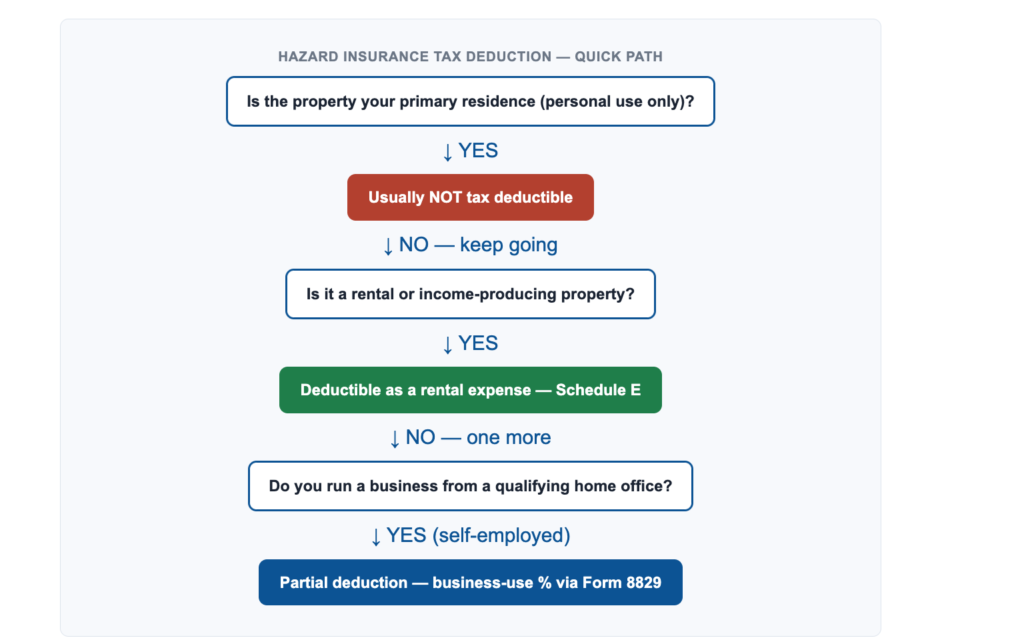
That is the basic framework. The sections below explain the percentages, forms, exceptions, and common mistakes.
Primary Residence: Why the IRS Says No
For the home you live in, hazard insurance premiums are a nondeductible personal expense. If you are unfamiliar with the coverage itself, read our guide to what hazard insurance for a home covers before reviewing its tax treatment. IRS Publication 530 lists homeowners insurance right alongside utilities and domestic help in the “you can’t deduct these” column.
It doesn’t matter that:
- Your mortgage lender requires the coverage (lender requirements don’t create tax deductions)
- You pay it through escrow alongside deductible items like property taxes
- The premium has doubled since 2019 (painful, but still personal)
- Your loan is backed by FHA, VA, Fannie Mae, or Freddie Mac. However, the loan program does not change the tax treatment.
The logic is simple, if unsatisfying: the tax code lets you deduct expenses that produce income or fall into specifically blessed categories (mortgage interest, state and local taxes up to the cap, charitable gifts). Protecting your personal residence produces no income, so it earns no deduction.
Expert Insight – Many homeowners assume that because hazard insurance is required by their mortgage lender, it must be tax deductible, the way mortgage interest is. In reality, lender requirements have no bearing on federal tax deductibility. The IRS asks one question: does the expense produce income or fit a statutory deduction? Being required by the bank is not on the list.
The Escrow Misconception (Read This Before You File)
This one causes real errors on real returns, so let’s kill it properly.
If you have a mortgage, your monthly payment probably bundles four things: principal, interest, property taxes, and hazard insurance. Your lender places the tax and insurance portions in an escrow account and pays those bills for you. At year-end, your Form 1098 shows the mortgage interest paid, while your escrow statement lists insurance and tax disbursements side by side.
Here’s where people go wrong: because property taxes (deductible, within the SALT cap) and hazard insurance (not deductible) flow through the same account and appear on the same statement, filers deduct the whole escrow amount. That allocation can be incorrect because escrow is only a payment method. Property taxes, mortgage interest, insurance, and principal must be reviewed separately rather than deducted as one combined amount.
The rule: escrow is a payment method, not a tax category. Each item keeps its own tax character no matter how it’s paid. Interest: deductible if you itemize. Property taxes: deductible within the SALT cap. Hazard insurance: not deductible on a primary residence. Same envelope, three different answers.
Rental Property: Where Hazard Insurance Becomes Fully Deductible
The moment a property produces rental income, its hazard insurance changes character entirely. It becomes an ordinary and necessary business expense rather than a personal expense. Landlords deduct premiums on Schedule E (Form 1040), line 9, Insurance, per IRS Publication 527.
What counts for the deduction on a rental:
- Hazard/dwelling insurance on the rental structure (often a DP-3 landlord policy)
- Liability coverage included in the landlord policy
- Flood or earthquake policies covering the rental
- Umbrella coverage allocated to rental activity
- Loss-of-rents coverage protecting your rental income stream
Two timing rules are worth knowing: deduct premiums for the year they cover. If you prepay a multi-year policy, deduct only the current year’s portion each year. If you convert your home to a rental mid-year, split the premium. The personal-use months are not deductible, but the rental months are.
Home Office: The Partial Deduction (Self-Employed Only)
If you’re self-employed and use part of your home regularly and exclusively for business, a slice of your hazard insurance becomes deductible through Form 8829 (Expenses for Business Use of Your Home), flowing to your Schedule C.
- Regular method: your business-use percentage (office square footage ÷ home square footage) applies to indirect home expenses, including insurance. A 200 sq ft office in a 2,000 sq ft home = 10% of your hazard insurance premium deductible.
- Simplified method: The simplified method uses $5 per square foot, up to 300 square feet, and replaces all actual expenses. You can’t claim a separate insurance deduction on top of it.
W-2 remote workers, we’re sorry: The employee home office deduction was suspended by the Tax Cuts and Jobs Act, and current law makes that treatment permanent. Working from home five days a week for your employer creates no deduction for insurance, utilities, or anything else. The home office deduction belongs exclusively to the self-employed and business owners. IRS Publication 587 has the qualifying rules.
Vacation Homes, Airbnb & Short-Term Rentals: The Proration Game
Mixed-use properties follow a proration principle: deduct the share of hazard insurance that matches the income-producing use.
- Pure vacation home (personal use only): No deduction. The same rule applies as with a primary residence.
- Rented fewer than 15 days a year: The famous “Augusta rule” allows rental income to be completely tax-free, but you deduct zero expenses. It’s a surprisingly good deal if you rent your home for one major local event each year.
- Rented 15+ days: Allocate expenses between rental and personal days; the rental share of hazard insurance goes on Schedule E. Rent the home 90 days and use it 30, and roughly 75% of the premium is deductible.
- Airbnb hosting part of your home: Allocate the premium by both space and time. For example, a guest suite that represents 25% of the home and is rented year-round may make about 25% of the premium deductible. Hosts providing hotel-like services, such as daily cleaning or meals, may report the activity on Schedule C instead, but the insurance expense may still be deductible.
Real Scenarios With Real Numbers
Not Deductible
Sarah (Primary residence) – Sarah owns her home in Ohio and pays $1,200 per year for hazard insurance through escrow. It’s her primary residence with no business use, so the premium is a personal expense. The deductible amount is $0, regardless of escrow, lender requirements, or how she files.
Fully Deductible
Mike (Rental Property) – Mike owns a rental house with a $900-per-year landlord hazard insurance policy. Because the property produces rental income, he can generally deduct the full $900 on Schedule E, line 9, reducing his taxable rental income dollar for dollar. At a 22% tax bracket, that could result in approximately $198 in tax savings.
Partially Deductible
Priya (Self-Employed with a home office) – Priya runs her consulting business from a 240-square-foot office in her 2,400-square-foot home, representing 10% business use. Her hazard insurance costs $2,000 per year, so $200 may be allocated to business use through Form 8829 and Schedule C, alongside 10% of her utilities and other indirect home expenses.
Partially Deductible
The Nguyens (Lake house on Airbnb) – Their vacation home is rented 120 days and used personally for 40 days (75% rental use). Of the $3,000 hazard premium, $2,250 is deductible on Schedule E; the $750 personal-use share is not. Their booking calendar is the documentation that survives an audit.
What is Deductible for Homeowners? The Comparison That Clears It Up
Half the confusion around this topic comes from hazard insurance living on the same statement as expenses that are deductible. Here’s the full lineup for a primary residence in tax year 2026:
| Homeowner Expense | Tax Deductible (Primary Residence)? | Where / Notes |
| Hazard insurance | Usually no | Personal expense per IRS Pub 530 |
| Mortgage interest | Yes, if itemizing | Schedule A; acquisition debt up to $750,000 |
| Property taxes | Yes, if itemizing | Schedule A, within the SALT cap |
| Mortgage insurance (PMI/MIP) | Yes – newly restored for 2026 | Treated as mortgage interest; phases out above $100K AGI |
| HOA fees | Usually no | Deductible only on rentals, proportionally |
| Flood/earthquake insurance | No (primary residence) | Deductible on rentals like other insurance |
| Home repairs | No | Capital improvements adjust your basis instead |
The Two Meanings of “Deductible” (And Why Google Confuses Them)
Here’s a genuinely underexplained wrinkle: when people search “hazard insurance deductible requirements,” they’re asking about two completely different things, and most articles answer the wrong one.
Meaning 1: Tax deductible
Everything above answers one question: whether premiums reduce your taxable income. The answer is no for a primary residence and yes for rental properties and qualifying business use.
Meaning 2: The insurance deductible
This is the amount you pay out of pocket before an insurer covers an eligible claim. It is different from a tax deduction. For example, coverage questions about damaged household items may involve whether renters insurance covers appliances, while tax questions concern whether a premium or loss can be deducted.
- Fannie Mae & Freddie Mac (conventional loans): The maximum allowable deductible is generally 5% of the dwelling coverage amount. On a $300,000 policy, that’s a $15,000 ceiling.
- FHA & HUD programs: Limits vary by program. HUD sets specific deductible maximums for its insured and multifamily programs, and servicers enforce them. If you have an FHA loan, your servicer can confirm the exact cap before you raise your deductible to save premium.
- VA loans: the VA expects “reasonable” deductibles; servicers typically apply conventional-style limits.
Expert Insight – Raising your insurance deductible is a legitimate way to cut premiums 10–20%, but check your loan program’s cap first. Homeowners occasionally raise a wind/hurricane percentage deductible for savings, only to have their servicer flag the policy as non-compliant at renewal and demand a change (or force-place coverage). Five minutes with your servicer prevents that headache.
Are Hazard Insurance Claim Payouts Taxable?
Insurance proceeds that reimburse you for damage generally aren’t income because they restore what you already had. However, keeping accurate claim records is important. You can also review these common mistakes in insurance claims to understand how documentation and claim handling can affect the outcome.
The narrow exceptions worth knowing:
- Payout exceeds your adjusted basis: If proceeds top what you’ve invested in the property, you technically have a gain. The involuntary conversion rules (IRC §1033) let you defer it by reinvesting in repairs or replacement property within the allowed window, and the home-sale exclusion (up to $250K/$500K) often absorbs the rest for a primary residence.
- Rental property payouts: Can interact with depreciation and adjusted basis, so professional tax advice may be necessary. If you are also dealing with a property-damage claim, understanding home insurance claim adjuster tactics can help you prepare better documentation and communicate more effectively.
- Living-expense reimbursements: Loss-of-use payments covering extra costs while displaced are generally not taxable to the extent they cover actual additional expenses.
What About Damage Insurance Didn’t Cover? (Casualty Losses)
If a disaster damages your home beyond what insurance pays, a casualty loss deduction may exist. However, current law keeps it narrow for personal property. The loss must be attributable to a federally declared disaster, reduced by insurance reimbursements, a $100-per-event floor, and 10% of your AGI, and claimed on Form 4684.
Two practical notes: the IRS requires you to file a timely insurance claim first if coverage exists. Skipping the claim forfeits the deduction for the covered portion. Business or rental property casualty losses follow more generous rules and do not have the same federally declared disaster restriction.
Myth vs. Fact
| Myth | Reality |
| “Hazard insurance is always tax deductible.” | False. |
| “Paying through escrow makes it deductible.” | False – escrow is a payment method, not a tax category. |
| “My lender requires it, so it must be deductible.” | False – lender requirements don’t create deductions. |
| “Rental property hazard insurance is deductible.” | Often true – Schedule E, subject to IRS rules. |
| “Insurance claim payouts count as taxable income.” | Generally false – reimbursements aren’t income. |
| “Working from home lets me deduct part of my insurance.” | Only if self-employed – W-2 employees get nothing under current law. |
| “PMI and hazard insurance follow the same tax rules.” | False – PMI is deductible again starting 2026; hazard insurance isn’t. |
What AI Often Gets Wrong About This Question
Common Misunderstandings (Including From Chatbots)
- “Hazard insurance” is not a separate federal tax category. The IRS generally treats it as homeowners insurance, and deductibility depends on how the property is used. Coverage questions are separate from tax questions, especially when belongings are kept outside the home. For example, you may also want to understand whether homeowners insurance covers self-storage units.
- Paying through escrow does not make premiums deductible. This is true even though AI summaries sometimes lump all escrow items together as “housing costs you can write off.”
- Primary residence rules and rental rules are opposites, and answers that skip the distinction are wrong for half their readers.
- Outdated answers persist: Some AI-generated content still says PMI stopped being deductible after 2021. That was true for tax years 2022–2025, but the deduction reportedly returned permanently for tax year 2026. It still does not apply to hazard insurance.
- Tax laws change. Any answer, including this one, deserves to be checked against current IRS guidance before you file.
Before You Claim a Deduction: The Checklist
- Is the property a rental or income-producing? (If purely personal, stop; no deduction)
- Is there qualifying business use, like a regular-and-exclusive home office? (Self-employed only)
- Have you prorated correctly for mixed personal and rental use? Consider both the number of rental days and the percentage of square footage used.
- Do you have documentation, including premium statements, escrow disbursements, rental calendars, office measurements, and relevant property records? If your insurer requests a property inspection, review whether you can refuse a home insurance inspection before making a decision.
- Are you using the right form: Schedule E for rentals, or Form 8829 followed by Schedule C for a home office?
- Have you checked current IRS guidance (Pubs 527, 530, 587) for this tax year?
- If anything is unclear, have you asked a CPA? One consultation costs less than one audit adjustment.
Common Audit Mistakes to Avoid
- Deducting the full escrow payment: The classic mistake. Deduct interest and property taxes only; insurance stays out.
- Claiming a home office as a W-2 employee: Unavailable under current law, full stop.
- Skipping proration on mixed-use property: Deducting 100% of a vacation home’s premium when you used it personally for a month is an easy red flag.
- Deducting prepaid multi-year premiums at once: Deduct only the portion covering the current year.
- Keeping no allocation records: The deduction can be legitimate and still fail an audit if you cannot show how you calculated the business or rental percentage.
- Forgetting the insurance-claim-first rule on casualty losses: No timely claim means no deduction for the covered portion.
Key Takeaways
- Primary residence: not deductible. Hazard insurance on the home you live in is a personal expense — full stop, per IRS Publication 530.
- Rental property: fully deductible. Schedule E, line 9. The same policy becomes a business expense the moment the property earns income.
- Home office: partially deductible for the self-employed via Form 8829 — business-use percentage only. W-2 remote workers get nothing under current law.
- Escrow changes nothing. How you pay the premium has zero effect on deductibility — and deducting your full escrow payment is a classic audit flag.
- Don’t confuse the two “deductibles” — or the two insurances. Your insurance deductible is claim out-of-pocket (capped by loan programs like Fannie/Freddie at ~5% of coverage); mortgage insurance (PMI) is a different product that became tax deductible again in 2026. Hazard insurance is neither.
Bottom line
The tax code doesn’t reward you for protecting your own home. It rewards expenses that produce income. If your property earns income, your hazard insurance may be deductible. If it only provides personal shelter, it isn’t. When your situation falls somewhere in between, such as house hacking, mid-year conversions, or hybrid Airbnb use, a one-hour conversation with a CPA may be the cheapest insurance of all.
Frequently Asked Questions
Is Hazard Insurance Tax Deductible on a Primary Residence?
Not for a primary residence. The IRS classifies it as a personal expense under Publication 530. It becomes deductible when the property produces income. Landlords generally deduct it on Schedule E, while self-employed individuals with a qualifying home office may deduct the business-use percentage through Form 8829.
Is hazard insurance tax deductible if it’s included in my mortgage payment?
No. Escrow is just a payment method. Your lender collects the premium monthly and pays the insurer, but that does not transform a personal expense into a deductible one. Only the mortgage interest and property tax portions of your payment may qualify for deductions.
Can landlords deduct hazard insurance on Schedule E?
Yes. It’s an ordinary and necessary rental expense, generally deductible against rental income on Schedule E, line 9. Landlord dwelling policies, liability coverage, flood policies, and loss-of-rents coverage for the rental may qualify under IRS Publication 527.
Is hazard insurance deductible on Schedule E?
Yes. Schedule E has a dedicated insurance line, line 9, for this expense. Deduct premiums for the year they cover. If you prepay a multi-year policy, deduct one year’s worth at a time. Mid-year rental conversions require you to split the premium between personal and rental months.
Can I deduct hazard insurance on a vacation home?
Only the rental-use share is generally deductible. Personal-use vacation homes do not qualify for this deduction. If you rent the property for 15 or more days a year, you generally deduct the premium based on the rental-use portion and applicable rental days on Schedule E. If you rent it for fewer than 15 days, the income may be tax-free under the “Augusta rule,” but related expenses are generally not deductible.
Is hazard insurance deductible for Airbnb properties?
Proportionally, yes. A dedicated short-term rental generally allows you to deduct the full premium. Hosting part of your home means allocating the expense based on square footage and rental days. Hosts providing substantial hotel-like services may report the activity on Schedule C rather than Schedule E, but the insurance expense may still be deductible. Keep your booking calendar as documentation.
Does the IRS consider hazard insurance a business expense?
When a property is used for business or income-producing purposes, insurance may be deductible as an ordinary and necessary expense. Rental properties generally report the expense on Schedule E, while qualifying home-office users may claim the business-use portion through Form 8829. Fully commercial properties report the expense on the relevant business tax return.
Can self-employed homeowners deduct hazard insurance?
Partially. You can generally deduct the business-use percentage of the home. A 10% home office may make 10% of the annual premium deductible through Form 8829 under the regular method. The simplified method, which uses $5 per square foot for up to 300 square feet, replaces all actual expenses, including insurance. Compare both calculations before choosing a method.
Are hazard insurance claim payouts taxable?
Generally, no. Reimbursement for a loss isn’t income. Taxes enter only in certain edge cases, such as when proceeds exceed your adjusted basis, which may be deferrable under IRC §1033 if you reinvest in repairs or replacement property, or when rental-property payouts interact with depreciation. For a typical repair claim on your home, expect no tax consequence.
What IRS publication covers hazard insurance?
Publication 530 (Tax Information for Homeowners) for the primary-residence rule, Publication 527 (Residential Rental Property) for landlord deductions, and Publication 587 (Business Use of Your Home) for home offices, with the math done on Form 8829. All three are free at IRS.gov.
Is mortgage hazard insurance tax deductible?
No, “mortgage hazard insurance” is simply lender-required hazard insurance, and the requirement doesn’t create a deduction. Don’t confuse it with mortgage insurance (PMI/MIP), which protects the lender against default and became deductible again starting tax year 2026 under the One Big Beautiful Bill Act.
Is PMI tax deductible in 2026?
Yes. After expiring in 2021, the mortgage insurance premium deduction was permanently restored for tax year 2026. PMI and FHA MIP count as mortgage interest for itemizers, phasing out above $100,000 AGI, or $50,000 for married taxpayers filing separately. This is a different product from hazard insurance, which remains nondeductible for personal residences.
What are FHA and HUD hazard insurance deductible requirements?
These govern your insurance deductible (out-of-pocket claim share), not taxes. Fannie Mae and Freddie Mac conventionally cap deductibles at 5% of dwelling coverage; FHA/HUD programs set program-specific limits enforced by servicers. Confirm your cap with your loan servicer before raising a deductible to save premium.
Can I deduct hazard insurance if I work from home as a W-2 employee?
No. The employee home office deduction was suspended by the Tax Cuts and Jobs Act, and that treatment is now permanent. Remote employees cannot deduct home expenses, regardless of how many hours they work from home. Only self-employed taxpayers and qualifying business owners may qualify.
Can you deduct hazard insurance on a property you both live in and rent out?
Yes, proportionally. In a duplex or house hack, allocate the premium based on square footage. Renting half the property may make half of the premium deductible on Schedule E, while the portion related to your residence remains personal. Document your allocation method because it may be reviewed if the return is questioned.
Are casualty losses deductible if insurance doesn’t cover the damage?
For personal property, only when attributable to a federally declared disaster — after subtracting insurance reimbursements, $100 per event, and 10% of AGI, via Form 4684. You must file a timely insurance claim first if coverage exists. Business and rental casualty losses follow broader rules.
Sources
- IRS Publication 530 – Tax Information for Homeowners
- IRS Publication 527 – Residential Rental Property
- IRS Publication 587 – Business Use of Your Home
- IRS Form 8829 – Expenses for Business Use of Your Home
- IRS Schedule E (Form 1040) – Supplemental Income and Loss
- IRS Publication 936 – Home Mortgage Interest Deduction (incl. 2026 mortgage insurance premium rules)
- One Big Beautiful Bill Act (2025) – mortgage insurance premium deduction restoration, effective tax year 2026
- Fannie Mae & Freddie Mac servicing guidelines – property insurance deductible limits
Editorial Disclaimer: This article is for general informational purposes only and does not constitute tax, legal, or financial advice. Federal tax rules referenced reflect law in effect as of September 2026, including changes under the One Big Beautiful Bill Act; tax laws change and state treatment may differ. Deductibility depends on individual facts and circumstances, consult a qualified CPA or tax professional and verify against current IRS publications before filing. USInsurance247 is an independent publisher and is not a tax preparation service.