


Written by the USInsurance247 Content Team | Reviewed by Rubi Chauhan, Insurance Advisor, USInsurance247.com | Last updated: September 2026
Quick Answer
To file a hazard insurance claim you need to make sure everyone involved is safe and prevent further damages. Once the loss is identified, start collecting photos of the damage and record it. It is necessary to file the claim with your insurance company quickly. Also, you’ll need to submit the necessary insurance documents to your company, work with an insurance adjuster, and save receipts until you get reimbursed.
Quick Facts
| Question | Answer |
| When to report | As soon as possible |
| Photos needed? | Yes — before touching anything |
| Temporary repairs allowed? | Yes, to prevent further damage (keep receipts) |
| Adjuster inspection | Usually required |
| Deductible applies? | Usually — subtracted from your payout |
| Claim number | Provided when you report the loss |
This guide is for you if you’re:
- Filing your first home insurance claim
- Dealing with storm, fire, hail, or wind damage
- A mortgage borrower wondering about the lender’s role
A fallen tree, storm-damaged roof, or burst pipe can leave homeowners unsure about what to do next. Here’s the truth: the first hour after discovering home damage often has the biggest impact on how smoothly your claim goes. Taking the right steps now prevents the delays, disputes, and reduced payouts that trip up so many homeowners later.
Knowing how to file a homeowners insurance claim for hazard damage comes down to a handful of steps done in the right order. Before deciding whether to file, it also helps to understand the common mistakes in insurance claims that can lead to delays, disputes, or reduced payouts.
What Damage Does Hazard Insurance Cover?
Before spending an hour on the phone, make sure your damage is actually claimable. The pattern: sudden and accidental gets covered; gradual and preventable doesn’t.
| Usually Covered | Usually NOT Covered |
| Fire & smoke | Flood (needs separate flood insurance |
| Windstorms & tornadoes | Earthquake (separate policy) |
| Hail | Termites & pest damage |
| Lightning | Wear & tear |
| Falling trees & objects | Mold from neglect |
| Vandalism & theft damage | Deferred maintenance |
Before filing, review the policy exclusions and confirm that the damage resulted from a covered peril. If you are unsure what hazard insurance covers, read our guide explaining what hazard insurance for a home covers before submitting a claim.
First: Should You Even File a Hazard Insurance Claim? (20-Second Decision Tree)
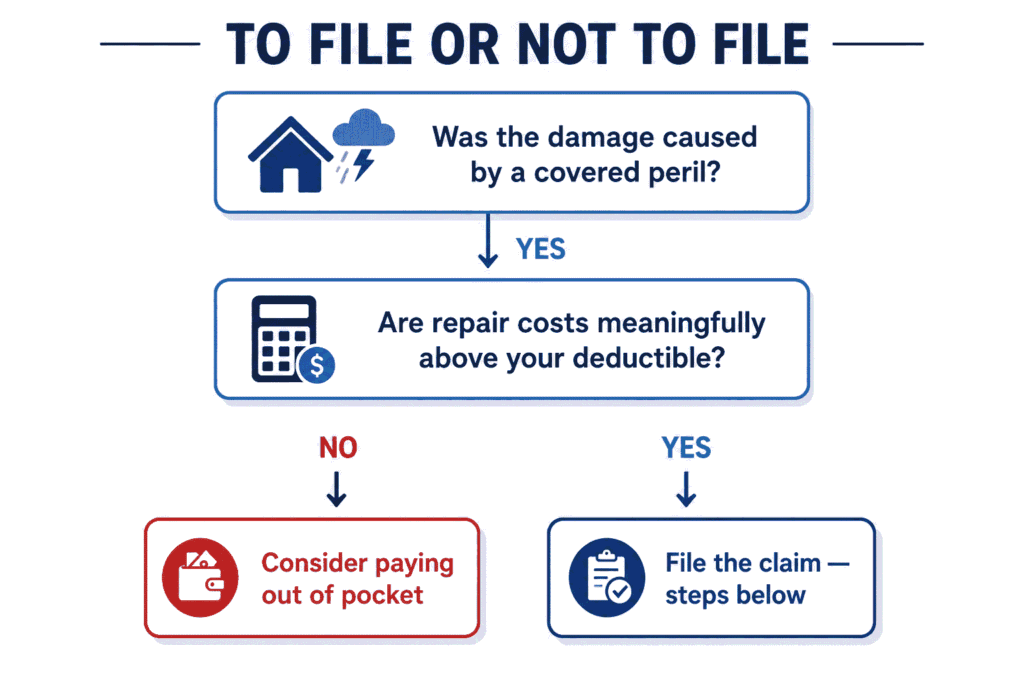
Why hesitate on small claims? If covered damage is estimated at $2,000 and your deductible is $1,500, the potential payment may be approximately $500 before considering policy limits, exclusions, and other conditions. Compare the expected benefit with the possible effect of filing a claim. Save insurance for losses that genuinely hurt. Unsure whether the peril is covered? Check our guide to how deductibles work and your declarations page before deciding.
Before You Call: The First-Hour Checklist
The NAIC’s homeowners claim guidance also recommends documenting damage, taking photos and videos, contacting the insurer promptly, and keeping information ready for the adjuster.
- Safety first – Get everyone out of harm’s way; call 911 for fire, gas smell, or downed lines
- Photograph and video everything – Wide shots and close-ups, before cleanup begins
- Stop further damage – Tarp the roof, shut off the water, board the window
- Keep damaged items and materials – They’re evidence, not trash
- Save every receipt – Emergency repairs and supplies are typically reimbursable
What to Do vs. What NOT to Do
| Do | Don’t |
| Take photos and videos of everything | Throw damaged items away |
| Keep receipts for emergency repairs | Start permanent repairs before inspection |
| Report the claim quickly | Wait weeks to notify your insurer |
| Collect independent contractor estimates | Accept the first settlement without reviewing it |
| Prevent further damage (tarp, shut off water) | Ignore spreading water or mold |
How to File a Hazard Insurance Claim: 7 Steps
1. Review your policy
Two minutes with your declarations page tells you your coverage limits, your deductible (including any percentage-based wind/hail deductible), and the exclusions that might apply.
2. Contact your insurer and get a claim number
Report by app, phone, or portal as soon as possible. Report the claim as soon as reasonably possible. Policies and state laws may set deadlines for reporting losses, and delays can make it harder to document the cause and extent of the damage.
3. Submit documentation and claim forms
Your photos, videos, and a completed proof of loss form are the backbone of the claim. Complete documentation is important, but you should still follow the insurer’s reporting and proof-of-loss deadlines.
4. Make temporary repairs (not permanent ones)
Insurers expect reasonable steps to prevent further damage and typically reimburse them. Avoid permanent repairs before the insurer has inspected the damage unless immediate action is necessary for safety or to prevent further loss. If emergency work is required, document the damage first and keep all receipts.
5. Meet the adjuster
Walk through the inspection with the adjuster and point out every damaged area on your list. Keep your own photos, notes, and supporting documents in case additional damage is discovered later.
6. Get contractor estimates and review the settlement
At least one independent quote gives you a useful benchmark. If the adjuster’s estimate falls short, you can negotiate, submit your contractor’s estimate, or request a re-inspection. Remember, first offers are often not final.
7. Get paid, then repair
Your payment arrives minus the deductible. With replacement-cost policies, some money, known as recoverable depreciation, is released only after the repairs are completed. Finish the work and submit your invoices to receive the remaining amount. Learn more in our RCV vs. ACV guide.
Mortgage lender heads-up: If you have a mortgage, the lender may be listed on a structural-damage payment because it has a financial interest in the property. The lender may require an endorsement process or release funds in stages, depending on its procedures.
Hazard Insurance Claim: What to Do at Each Stage
|
Claim Stage |
What You Should Do |
What to Avoid |
|---|---|---|
|
Immediately after damage |
Ensure safety and prevent further damage |
Entering unsafe areas |
|
Before cleanup |
Take photos, videos, and notes |
Throwing away damaged items |
|
Reporting the claim |
Contact the insurer and record the claim number |
Waiting unnecessarily |
|
Adjuster inspection |
Share your damage list and evidence |
Guessing or exaggerating losses |
|
Repair estimates |
Get written estimates and compare them |
Accepting the first offer without review |
|
Repairs |
Keep receipts and document progress |
Making permanent repairs without checking requirements |
|
Final payment |
Review the settlement and submit required invoices |
Assuming the first payment is always final |
Documents You’ll Need
| Document | Why It Matters |
| Policy / claim number | Identifies your coverage and file |
| Photos & videos | Primary evidence of the damage |
| Contractor repair estimates | Supports (or challenges) the claim value |
| Receipts for emergency repairs | Reimbursement for out-of-pocket costs |
| Home inventory list | Documents personal property losses |
| Police or fire report | Official record for theft, vandalism, or fire |
How Long Does a Hazard Insurance Claim Take?
| Stage | Typical Timeframe* |
| Report the claim | Same day |
| Insurer’s initial contact | 1–3 business days |
| Adjuster inspection | Days to a few weeks (longer after regional catastrophes) |
| Review & settlement offer | A few weeks for straightforward claims |
| Payment | Shortly after agreement; staged for lender-involved checks |
*Claim timelines vary by insurer, state regulations, and the complexity of the loss. Most states set legal deadlines for insurers to acknowledge and decide claims. Check your state insurance department’s website for the deadlines that apply to your claim.
The whole journey at a glance
- Damage occurs Safety first, then stop further damage
- Document everything Photos + video before cleanup
- Call your insurer Claim number issued
- Adjuster visit Walk the inspection with them
- Estimate & settlement Compare against contractor quotes
- Repairs Permanent work begins after approval
- Final payment Recoverable depreciation released on completed RCV claims
After Your Claim is Approved: The Part Nobody Explains
Getting a settlement approved may feel like the finish line, but the process isn’t over yet. Here are the final steps:
Lender endorsement: If you have a mortgage, the structural claim check may list both you and your lender. The lender may endorse the check and release the funds in stages as repairs progress. It may also conduct its own inspection before releasing additional payments.
Paying the contractor: Claim payments are often made to the policyholder and, when applicable, the mortgage lender. Some contractors may request an assignment-of-benefits agreement, so read the document carefully and understand what rights you may be transferring before signing.
Recoverable depreciation: With replacement-cost policies, the insurer may initially hold back depreciation. Once you complete the repairs and submit the required invoices, that amount may be released. Failing to complete the paperwork could mean losing out on money you may be entitled to receive.
Final inspection & closing: Once the repairs are complete and all payments have been settled, the claim can be closed. Keep the complete claim file, including photos, estimates, receipts, and correspondence, for several years. These records may help with future claims, property sale disclosures, or disputes about premiums.
A Real-World Example: Sarah’s Hail Claim
The situation: A spring hailstorm hammered Sarah’s roof. Her contractor’s repair estimate came to $18,000; her policy carried a $2,000 deductible.
The claim: She photographed the roof and ceiling stains the same day, filed immediately, and walked the inspection with the adjuster. The insurer approved the estimate and paid $16,000 ($18,000 minus her $2,000 deductible).
The twist: When roofers pulled the shingles, they found hidden decking damage the inspection couldn’t see. Sarah’s contractor documented it, her adjuster reviewed the photos, and the insurer approved a supplemental payment for the extra work.
The lesson: Claims aren’t always one-and-done. If legitimate damage surfaces during repairs, document it and ask for a supplement. Insurers process these requests routinely.
7 Common Claim Mistakes
- Waiting too long to report the loss
- Cleaning up before taking photos
- Throwing away damaged materials is a mistake. They may serve as evidence for your claim.
- Not knowing your deductible (especially percentage wind/hail deductibles)
- Signing a contractor before claim approval
- Accepting the first estimate without an independent quote
- Losing receipts for emergency repairs and temporary housing
Why Claims Get Delayed or Denied
The usual suspects: late reporting, thin documentation, damage from excluded perils (flood and earthquake top the list), long-term maintenance neglect dressed up as sudden damage, a lapsed policy, or misrepresentation on the claim. A denial is not always the end of the process. Depending on the policy and state rules, you may be able to submit additional evidence, request a re-inspection, use an appraisal clause, or contact your state insurance department. If the claim was closed and new damage later appears, learn whether a closed insurance claim can be reopened.
Expert Tip – The single best claim move happens before any disaster: build a home inventory today. Walk through your house filming a slow video tour, narrating big-ticket items, and store it in the cloud along with your policy documents. When the worst happens, that ten-minute video becomes the most valuable file you own.
Key Takeaways
Remember These Five Things
- Document before you clean. Photos and videos taken before cleanup are the strongest evidence you’ll ever have.
- Report fast, repair slow. Notify your insurer immediately; save permanent repairs for after the adjuster’s inspection.
- Know your deductible, including percentage-based wind or hurricane deductibles, before you decide whether filing makes sense.
- First offers are negotiable. An independent contractor estimate is your leverage.
- Keep everything, including receipts, emails, damaged materials, and the adjuster’s name.
- Keeping organized records can make the claims process easier and help prevent avoidable delays.
Conclusion
Filing a hazard insurance claim becomes easier when you act quickly, document the damage carefully, and understand your policy before accepting a settlement. Start by protecting everyone’s safety, preventing further damage, taking photos, and notifying your insurer as soon as possible. Keep receipts, estimates, contractor records, and all communication throughout the process. If the adjuster misses covered damage or the repair costs exceed the initial estimate, request a re-inspection or supplemental payment with supporting documentation. Most importantly, review your deductible, coverage limits, exclusions, and settlement terms before moving forward.
Frequently Asked Questions
How do I start a hazard insurance claim?
First, photograph and videotape the damage. Immediately report your loss by calling, texting, messaging through an app, or logging into your insurer’s Web portal to get a claim number and an adjuster assigned to you. Repair any damage that may worsen to the extent that’s reasonably possible; keep all your repair receipts.
Will filing a claim increase my premium?
It can. One weather-related claim usually has modest impact, but multiple claims within a few years often raise rates or complicate renewal. That’s exactly why claims barely above your deductible are usually better paid out of pocket.
Can I choose my own contractor?
Yes, you’re generally free to hire any licensed contractor, even if your insurer suggests preferred vendors. Preferred vendors can simplify billing, but an independent estimate is still worth getting as a benchmark against the adjuster’s numbers.
Can I make temporary repairs before the adjuster arrives?
Yes, insurers expect you to prevent further damage, and reasonable temporary repairs like tarping a roof are typically reimbursable with receipts. Photograph everything first, keep the damaged materials, and hold permanent repairs until after the inspection.
What happens if repair costs exceed the initial estimate?
Contact your adjuster and provide the contractor’s documentation. If legitimate additional damage or repair costs are discovered, ask your insurer to review a supplemental payment. This is especially relevant for roof and water damage, where the full extent of the loss may not become clear until repairs begin.
What if my claim is denied?
Request the denial in writing with the policy language cited, then compare it against your actual policy. From there you can submit new documentation, request re-inspection, invoke the appraisal clause if your policy has one, or file a complaint with your state insurance department.
How long do I have to file a hazard insurance claim?
Policies require “prompt” notice, and many set explicit windows, commonly one year from the date of loss, although the deadline varies by insurer and state. Some states allow two years. Practically, file within days. The longer you wait, the harder it becomes to prove that the damage resulted from that event.
Can I reopen a hazard insurance claim?
Usually yes, within your policy’s time limits. If related damage surfaces after the claim closes, such as hidden water damage or roof issues missed during the inspection, contact your adjuster with supporting documentation and request a supplemental payment or claim reopening. This is a common example of why keeping complete claim records matters.
Does insurance pay the contractor directly?
Rarely. Payment typically goes to you and, on structural claims, your lender. You then pay the contractor. Be cautious with “assignment of benefits” agreements that allow a contractor to deal directly with your insurer. These agreements have been associated with inflated claims and disputes in several states.
Can I switch contractors mid-claim?
Yes. The policy belongs to you, not the contractor. If you change contractors, notify the adjuster, keep records of completed work and payments, and confirm how the remaining claim funds will be handled.
What if the adjuster missed damage during inspection?
Document what was missed, including photos and contractor notes, and request a re-inspection or submit a supplemental claim. Adjusters often handle heavy caseloads after storms, so mistakes can happen. That is why attending the inspection personally and keeping your own damage list is important.
Does hazard insurance cover roof damage claims?
Yes, when the cause is a covered peril like wind, hail, or a fallen tree. Roof claims are among the most common hazard claims filed. Age-related deterioration isn’t covered, and older roofs may be paid at depreciated actual cash value rather than full replacement cost, depending on your policy.
Editorial Disclaimer: This guide is for informational purposes only and does not constitute insurance, legal, or financial advice. Claim procedures, deadlines, and requirements vary by insurer and state. Always review your policy documents and contact your insurance company for claim-specific guidance. Sources include the National Association of Insurance Commissioners (NAIC), Insurance Information Institute (Triple-I), and Consumer Financial Protection Bureau (CFPB). USInsurance247 is an independent publisher.