

Written by the USInsurance247 Content Team | Reviewed by Rubi Chauhan, Insurance Advisor, USInsurance247.com | Last updated: September 2026
Quick Answer
Your mortgage payment can increase for several reasons — even with a fixed-rate loan and an unchanged balance. The most common causes: higher property taxes, a bigger homeowners insurance premium, an escrow shortage, PMI changes, or an adjustable-rate mortgage (ARM) reset. Your escrow analysis letter — the one most people file unread — explains exactly which one hit you. On fixed-rate loans, the answer is almost always taxes or insurance, not your interest rate.
“Why did my mortgage payment increase? I have a fixed rate.” If you’ve typed some version of that — or its cousin, “why did my monthly mortgage payment increase” — this month, you’re in very good company. Here’s the twist most homeowners never get told at closing: a fixed rate only fixes half of your payment. The other half can change with your insurance and tax bills. If your homeowners insurance premium increased, understanding what hazard insurance actually covers can help you determine whether you’re comparing similar policies before switching coverage.
The Anatomy of a Mortgage Payment (Why “Fixed” Isn’t Fully Fixed)
Most mortgage payments have four parts — PITI:
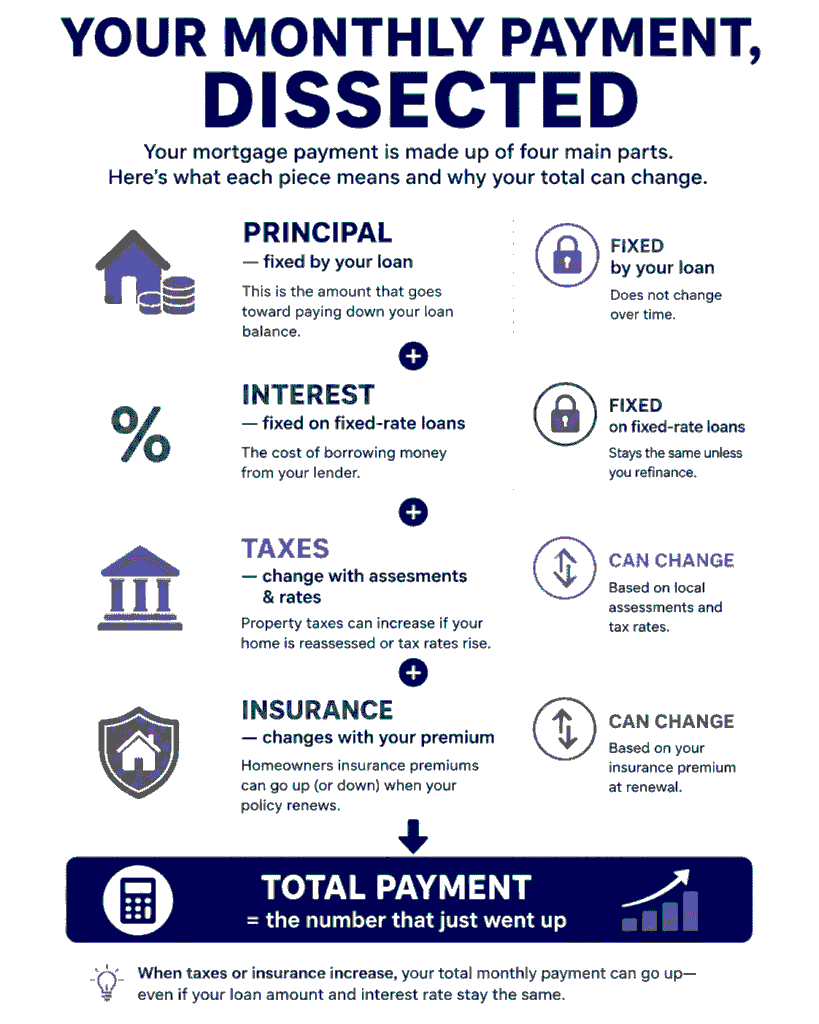
On a fixed-rate mortgage, the interest rate and scheduled principal-and-interest payment generally remain fixed. However, property taxes and homeowners insurance premiums can change, which can increase the total payment when those costs are paid through escrow.
12 Reasons Your Monthly Mortgage Payment Increased
| Reason | How Common? | Can You Reduce It? |
| Homeowners insurance premium rose | Very common | Yes, shop your policy |
| Property taxes increased | Very common | Sometimes, appeal the assessment |
| Escrow shortage repayment | Very common | Yes, pay lump sum instead |
| Property reassessment after purchase | Common | Sometimes |
| ARM interest rate reset | Common | Limited , consider refinancing |
| PMI added or repriced | Common | Yes , remove when eligible |
| Flood insurance added or repriced | Sometimes | Possibly |
| Force-placed insurance added | Less common | Yes, restore your own coverage |
| Loan modification terms | Less common | Depends |
| Missed/returned escrow payment | Rare | Yes |
| Servicer error | Rare | Yes, dispute it |
| New insurance requirement (e.g., flood zone remapping) | Rare | Depends |
Escrow Shortage – The #1 Culprit
Here’s the mechanism behind most increases. Say your homeowners insurance jumped from $1,800 to $2,400 mid-cycle. Your escrow account was collecting for $1,800, so when the servicer paid the $2,400 bill, the account went negative — an escrow shortage. At the next annual analysis, your payment rises twice over:
Going forward: +$50/month to collect the new, higher premium ($600 ÷ 12)
Looking backward: +$50/month for 12 months to repay the $600 shortage
A $600 premium increase just became a $100/month payment jump — which is why the increase always feels bigger than the underlying cause. After the shortage is repaid, the payment drops back to reflect only the new premium level.
Worth knowing: an escrow shortage doesn’t mean you owe extra interest or did anything wrong — it just means your escrow account didn’t have enough to cover taxes or insurance. Depending on the size of the shortage and the applicable escrow rules, your servicer may require repayment over time or allow other repayment options. Check your escrow analysis statement or ask the servicer how the shortage will be handled.
For more details, see the CFPB escrow account rules, which explain how servicers calculate shortages, surpluses, and annual escrow payments.
Did Your Homeowners Insurance Premium Increase?
In 2026, this is the odds-on favorite. Premiums have been climbing across the U.S. driven by severe weather losses, rebuilding-cost inflation, and insurer rate filings — with some states seeing double-digit annual increases. Your own claims history and even your roof’s age feed into it too.
The fix is also the most actionable on this list: shop the policy before renewal. Compare quotes for similar coverage, review how to file a hazard insurance claim so you understand how the policy works after a covered loss, and consider whether a higher deductible makes sense. If you switch, follow the right sequence — new policy first, declarations page to the servicer, then cancel — or you’ll trade a premium problem for a lapse problem.
Did Your Property Taxes Go Up?
The other heavyweight. Property taxes rise through reassessment (your home’s assessed value increased — very common in the first year or two after buying, when the county catches up to your purchase price), local rate changes, or new levies like school bonds.
Check the reassessment notice your county mailed — and note that many counties let you appeal within a set window, typically by showing comparable homes assessed lower or errors in your property record. A successful appeal flows straight back into a smaller escrow payment.
Is Your ARM Resetting?
If you have an adjustable-rate mortgage, the introductory fixed period (often 5, 7, or 10 years) eventually ends, and your rate adjusts with a market index — moving your principal-and-interest payment itself, not just escrow. Caps limit each adjustment and the lifetime maximum, but a first reset can still sting. If you’re near a reset, compare the capped worst case against current refinance rates before deciding anything.
PMI: Added, Repriced or Removable?
Private mortgage insurance appears on conventional loans with less than 20% down. The good news runs in your favor over time: you can request PMI cancellation at 80% loan-to-value, and under the Homeowners Protection Act your servicer must automatically terminate it at 78% of the original value. If home prices have risen in your area, a new appraisal may get you to 80% sooner than your amortization schedule suggests — one of the few phone calls that can permanently lower your payment.
The Nasty One: Force-Placed Insurance
If your own homeowners policy lapsed — missed payment, a botched insurer switch, a non-renewal you missed — your lender can buy force-placed insurance on the home and charge it to your escrow. Force-placed insurance can be significantly more expensive than a homeowners policy purchased directly by the borrower, and it may provide narrower coverage. If a sudden, large increase appeared mid-year with a line item you don’t recognize, check for this first: restoring your own coverage forces its removal within 15 days plus refunds for any overlap.
Common Mistake: Short-paying the mortgage — sending the old, lower amount because you dispute the increase. Servicers treat it as a partial payment, which can sit in suspense, trigger late fees, and hit your credit. Dispute loudly, but pay the billed amount while you do.
Diagnose Yours in 5 Steps
- Read the escrow analysis letter. It itemizes last year’s projections against actual bills – the answer is usually right there.
- Compare insurance declarations pages, this year vs. last. Premium difference ÷ 12 ≈ your monthly impact.
- Pull your property tax bill and look for a reassessment or rate change.
- Scan the mortgage statement line by line for new items – PMI, flood insurance, or lender-placed coverage you didn’t authorize.
- Call the servicer if the math doesn’t add up and request a written explanation. When reviewing insurance-related documents, also watch for common mistakes in insurance claims that could lead to confusion about coverage, payments, or policy information.
Can You Lower the Payment? (Cause → Fix)
| Cause | Your Move |
| Insurance premium increased | Shop 2–3 quotes before renewal; adjust deductible |
| Property taxes rose | Appeal the assessment if comparables support it |
| Escrow shortage | Pay it as a lump sum to limit the monthly hit |
| PMI on the loan | Request removal at 80% LTV; automatic at 78% |
| ARM reset | Compare capped payments vs. refinancing |
| Force-placed insurance | Restore your own coverage; demand removal + refund |
Good to Know: Escrow works both directions. If your insurance or taxes drop, the annual analysis produces a surplus — and surpluses of $50 or more must be refunded to you under RESPA. Shopping your insurance isn’t just defense; it’s one of the few ways to make next year’s mortgage payment smaller.
Key Takeaways
- A higher payment rarely means a higher rate — on fixed loans, it’s almost always taxes or insurance moving through escrow.
- Escrow shortages double the sting — new higher rate plus 12 months of repayment — then ease after year one.
- The escrow analysis letter is the answer key — read it before calling anyone.
- Some increases are reversible: shop insurance, appeal assessments, remove PMI, kill force-placed coverage.
- Never short-pay while disputing — pay the billed amount and fight with paperwork, not partial payments.
Final Thoughts
A mortgage payment can increase even when your interest rate stays the same. The most common causes are higher homeowners insurance premiums, property taxes, escrow shortages, PMI changes, or, for adjustable-rate mortgages, a rate reset.
Start with your escrow analysis statement and compare it with your latest insurance and property tax bills. Once you identify the cause, contact your servicer about the available options and avoid assuming that the previous payment amount is still sufficient.
Frequently Asked Questions
Why did my mortgage payment increase with a fixed-rate loan?
Because the rate only fixes principal and interest. Taxes and insurance flow through escrow, and when those bills rise, the total payment rises — the rate never moved, but half your payment floats.
Can my mortgage payment increase every year?
Yes — escrow is analyzed annually, and in today’s insurance market, yearly adjustments are common. It can also decrease when premiums or taxes fall, with $50+ surpluses refunded to you.
How do I know if insurance caused the increase?
Compare this year’s declarations page with last year’s. Divide the premium difference by 12 for the ongoing monthly impact, and expect a temporary shortage repayment on top for the first year.
Can I appeal a property tax increase?
Usually, within a window after reassessment notices go out. Winning appeals typically show comparable homes assessed lower or errors in your property record — and success flows back into a lower escrow payment.
Can removing PMI lower my payment?
Yes — request cancellation at 80% loan-to-value or wait for automatic termination at 78% under the Homeowners Protection Act. Rising home values plus a new appraisal can get you there early.
What if I just don’t pay the higher amount?
Short payments can sit in suspense, generate late fees, and reach your credit report. If the new amount is genuinely unaffordable, call the servicer about a lump-sum shortage payoff or hardship options instead.
How often are escrow accounts reviewed?
Annually under RESPA. A mid-year increase outside that cycle usually means a new escrow item — like force-placed insurance — and deserves an immediate call asking what changed.
Can the servicer simply have made a mistake?
It happens — wrong premium amounts, duplicate insurance payments, tax bills applied to the wrong parcel. That’s why the five-step diagnosis matters: compare their numbers against your actual bills, and dispute in writing with documentation.
Editorial Disclaimer: This article is for general informational purposes and is not financial, legal, tax, or mortgage advice. Escrow analysis rules, PMI cancellation thresholds, and surplus refund requirements referenced reflect RESPA/Regulation X, the Homeowners Protection Act, and CFPB guidance as of September 2026; specifics vary by loan type, lender, and state. Property tax appeal procedures vary by county. Review your loan documents and consult your servicer or a licensed professional about your situation.