


Written by the USInsurance247 Content Team | Reviewed by Rubi Chauhan, Insurance Advisor, USInsurance247.com | Last updated: October 2026
Quick Answer
Answer to the question “Can you have a mortage without homeowners insurance”? – In almost all cases, no – you cannot keep a mortgage without homeowners insurance. Here’s the twist: U.S. law generally does not require homeowners insurance. Your mortgage contract does. If your policy lapses or is canceled, your lender can purchase force-placed insurance – expensive coverage that protects them, not you – and charge it to your payment. The requirement ends only when the loan does.
At a Glance
| Question | Quick Answer |
| Is homeowners insurance legally required? | Usually no — no state mandates it |
| Is it required by mortgage lenders? | Almost always — it’s in the contract |
| Can you cancel your policy? | Yes, but you must replace it first |
| Can your lender buy insurance for you? | Yes — force-placed, at your cost |
| Can you remove force-placed insurance? | Yes — provide proof of your own policy |
If you’re asking “can you have a mortgage without homeowners insurance,” odds are you’re really asking one of two quieter questions: “can I save money by dropping this policy?” or “my coverage just got canceled — how much trouble am I in?” This guide answers both honestly — including the affordability strategies that actually work, because “just pay it” isn’t advice.
Is Homeowners Insurance Required by Law?
Here’s the distinction most articles blur, and it changes how you think about the whole question: no U.S. state legally requires homeowners insurance. Unlike auto liability coverage – which states mandate because your driving can hurt other people — your house burning down is legally your own problem. Own your home outright, and you can legally go without coverage tomorrow (whether you should is another matter).
So where does the requirement come from? The private contract you signed at closing. Your mortgage agreement – whether conventional, FHA, VA, or USDA — requires continuous hazard insurance on the property until the loan is paid off. Fannie Mae and Freddie Mac servicing guidelines, which govern most American mortgages, spell out the minimum coverage servicers must enforce.
Legal vs. contractual, in one line: the government doesn’t make you insure your home — your lender does, because until the loan is paid off, your home is their collateral.
Why Do Lenders Care So Much?
Simple math. On a $300,000 loan, the lender’s security is the house itself. If it burns uninsured, they’re holding a promissory note backed by a charred lot — from a borrower who now has excellent reasons to stop paying. Insurance is how lenders make sure the collateral survives whatever happens to it. That’s also why your lender appears on your policy as mortgagee: they get paid from structural claims, and they get copies of cancellation notices — which is exactly how they find out when coverage lapses, usually within days.
Are There Any Real Exceptions?
A few — and knowing them clarifies why your loan almost certainly isn’t one:
- Paid-off homes – The only true exit. Once the loan is satisfied and the lien released, insurance is entirely your call.
- Raw land loans – Nothing built means nothing to insure; hazard insurance requirements typically start when a structure exists.
- Construction loans – Often use builder’s risk coverage during the build instead of a homeowners policy, converting at completion.
- Portfolio lenders – Banks keeping loans on their own books can write custom terms; a handful negotiate unusual insurance arrangements. Rare, and usually for high-net-worth clients.
- Institutional self-insurance – Large corporate borrowers sometimes self-insure across property portfolios. Not a homeowner option.
Notice what’s not on the list: any standard home loan. If you have a normal mortgage on a house you live in, the requirement applies to you.
What Actually Happens If You Cancel?
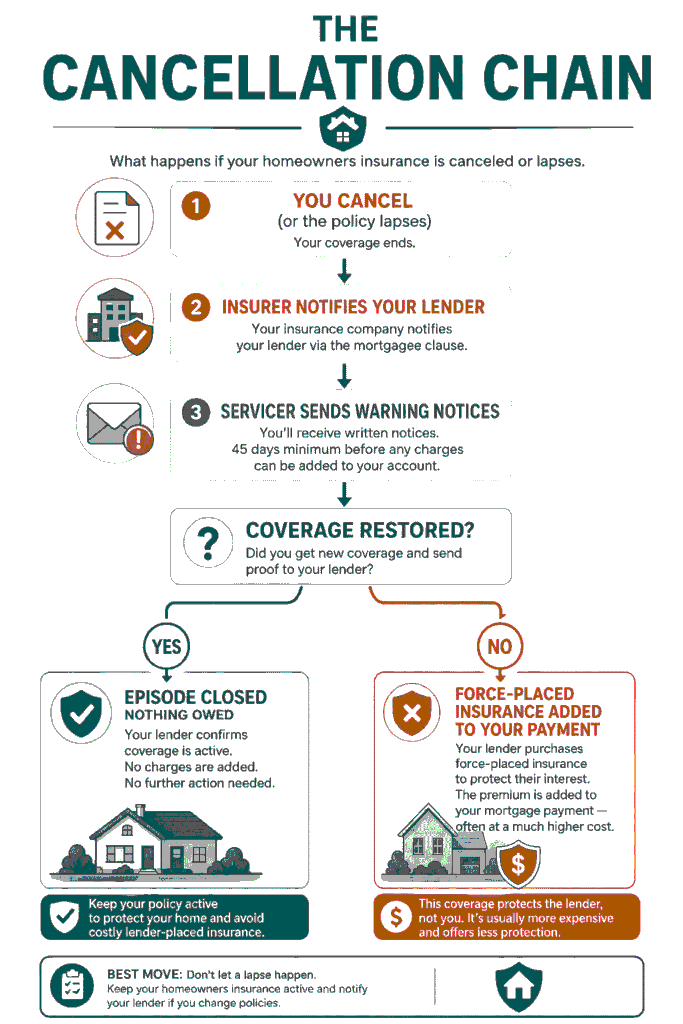
Those warning windows are federal law (CFPB Regulation X), not lender kindness — and they’re your repair kit. The full timeline, notice by notice, is in our insurance lapse guide.
Force-Placed Insurance: What “Saving Money” Actually Buys You
If the hidden question behind your search is “can I save money by canceling my policy?” — here’s the honest arithmetic of what replaces it. The CFPB’s guidance on force-placed homeowners insurance also explains what borrowers should know when a lender places insurance on a property.
| Your Homeowners Policy | Force-Placed Insurance | |
| Chosen by | You — you can shop it | The lender |
| Your belongings | Covered | Usually not |
| Your liability | Covered | Usually not |
| Hotel costs after a disaster | Covered (ALE) | Usually not |
| Price | Market rate | Often 2–10× more |
| Protects | You and the lender | Primarily the lender |
Canceling a $2,000 policy to “save money” and receiving a $6,000 force-placed policy that covers none of your stuff is the single worst trade in home finance. Our force-placed insurance guide covers removal and refunds in detail — the short version: send proof of your own coverage, and it must be canceled within 15 days with overlapping premiums refunded.
Does an Escrow Account Change Anything?
It changes your odds. With an escrow account, the servicer pays your premium directly — so accidental lapses are rare, missed-payment cancellations mostly disappear, and if a problem does arise, CFPB rules generally push escrowed loans toward advancing funds to continue your existing policy rather than force-placing. Without escrow, you pay the insurer directly, detection of lapses is slower, and the responsibility for continuous coverage sits entirely on your calendar. Either way, the contractual requirement is identical — escrow just automates compliance.
Can’t Afford the Premium? Do This Instead of Canceling
With premiums up sharply in many states, this is the real question for a lot of homeowners in 2026 — and letting the policy lapse is the one answer that always makes it worse. Work this list first:
Shop 2–3 quotes before renewal – Pricing gaps of 30–40% for identical coverage are common; loyalty is expensive
Raise your deductible – Moving from $1,000 to $2,500 can cut premiums meaningfully; see our deductible guide for the trade-offs. Before changing your coverage, it’s also useful to understand how to file a hazard insurance claim and what the policy may cover when you need to make a claim.
Ask about every discount – Bundling, new roof, security systems, claims-free history, paperless billing
Review coverage limits with an agent – You need full rebuild cost on the dwelling, but over-insured extras can sometimes be trimmed. If you’re reviewing the cost of your policy, you can also learn is hazard insurance tax deductible and whether any tax treatment may apply to your situation.
Ask the insurer about payment plans – Monthly or quarterly billing beats cancellation every time
Check your state’s FAIR plan – If standard insurers have declined you (common in wildfire and coastal markets), these state-backed programs provide last-resort coverage that satisfies lenders
Good to Know: Cutting coverage below your lender’s requirements doesn’t satisfy the mortgage agreement — a policy that’s too thin can trigger the same force-placed process as no policy at all. Trim smartly: deductibles and discounts, not dwelling coverage.
Common Mistake: Canceling the old policy before the new one starts when switching insurers. Even a one-day gap can set off lapse notices and backdated force-placed charges. New policy first — with your lender listed as mortgagee — then cancel. Always in that order.
Key Takeaways
- Legal requirement: no. Contractual requirement: absolutely — and the contract is what governs your loan.
- The requirement ends at payoff, not at “almost paid off.”
- Canceling to save money backfires — force-placed insurance costs 2–10× more and covers none of your stuff.
- Can’t afford it? Shop, raise deductibles, hunt discounts, check FAIR plans — everything beats a lapse.
- Switching insurers is always allowed — new policy first, declarations page to the servicer, then cancel.
Frequently Asked Questions
Can I legally have a mortgage without homeowners insurance?
The law won’t stop you — no state mandates homeowners insurance. Your mortgage contract will: virtually every home loan requires continuous coverage, and lenders enforce it with tracking systems and force-placed insurance.
Can I drop coverage if my home is almost paid off?
Not until it’s fully paid off and the lien is released. A $5,000 remaining balance carries the same insurance requirement as a $500,000 one. After payoff, it’s your call — though insuring your largest asset usually remains the smart one.
What happens if my insurance lapses?
Your insurer notifies the lender, warning notices follow (45 days minimum before charges under CFPB rules), and unresolved lapses end in force-placed insurance on your payment. Restore coverage within the window and it costs nothing.
Does force-placed insurance cover my belongings?
Generally no — it protects the dwelling for the lender only. No personal property, no liability, no hotel costs after a disaster, at several times the price of coverage you’d pick yourself.
Are there mortgages that don’t require insurance?
Edge cases only: raw land loans, construction loans using builder’s risk, some portfolio lenders, and institutional self-insurance. Standard home loans — conventional, FHA, VA, USDA — all require it.
Will canceling my policy hurt my credit?
Not directly — cancellations aren’t credit events. The damage arrives indirectly when force-placed premiums inflate your payment and missed mortgage payments follow. The cancellation is invisible; the chain reaction isn’t.
Can I switch insurance companies with a mortgage?
Anytime — lenders require coverage, not loyalty. Overlap the dates, list the lender as mortgagee on the new policy, send the servicer the declarations page, then cancel the old one.
Is hazard insurance the same as homeowners insurance?
Hazard insurance is the dwelling-coverage slice inside a homeowners policy — the part lenders require. The full policy adds belongings, liability, and living expenses, which protect you rather than the bank. Our comparison guide breaks it down.
Disclaimer
This article is for general informational purposes and is not legal, financial, or insurance advice. Insurance requirements are set by individual mortgage agreements and vary by loan type, lender, and state; force-placed insurance rules referenced reflect CFPB Regulation X and Fannie Mae/Freddie Mac servicing guidelines as of October 2026. FAIR plan availability and terms vary by state. Review your mortgage documents and consult your loan servicer, insurer, or a licensed professional about your specific situation.