

Written by the USInsurance247 Content Team | Reviewed by Rohit Negi, Insurance Expert, USInsurance247.com | Last updated: September 2026
Quick Answer:
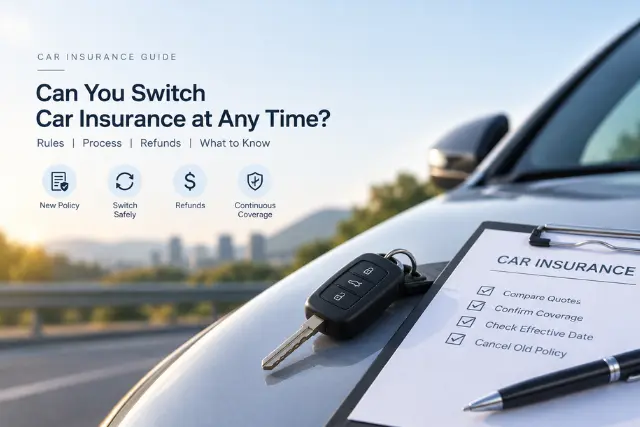
Yes, in most cases you can switch car insurance at any time — even before your policy expires. The safest approach is to buy your new policy first, confirm its effective date, then cancel the old policy so you never have a gap in coverage. Depending on your insurer and state, you’ll usually get a prorated refund for the unused portion of your premium, though a few charge a small cancellation fee.
That’s the whole thing in a nutshell. Before switching, it’s also important to understand what full coverage car insurance covers so you can compare your existing protection with a new policy. Now let’s walk through the details that can help you switch without creating a coverage gap.
Can You Switch Car Insurance at Any Time?
Here’s the core rule: a car insurance policy isn’t locked in until renewal. You’re not stuck until your term ends, and you don’t owe your insurer an explanation. You can switch car insurance companies at any time, whether you’re two weeks into a six-month term or two days from renewal.
Quick fact: Auto insurance policies can be canceled by the policyholder at any point. Unlike a cell phone contract, there’s no early-termination penalty in most states — at worst, a small short-rate fee with certain insurers.
The one caveat worth remembering: rules around refunds and cancellation fees vary by insurer and by state. So while the ability to switch is nearly universal, the fine print on how you get your money back is where the differences live. Always confirm the specifics with your insurer or your state insurance department.
The Coverage Gap Timeline: Do This, Not That
This single concept protects you more than anything else in this guide. When you switch, your new policy must start the same day your old one ends — no gap, not even one day.
The correct way (no lapse):
Old Policy ──────────────|
New Policy |──────────────
↑
Old ends & new starts the SAME day
The wrong way (dangerous lapse):
Cancel old policy
↓
Wait 2 days
↓
Buy new policy
↓
Coverage lapse = higher future rates + legal risk
Even a 48-hour gap can raise your premiums for years and, in some states, trigger registration suspensions or DMV fines. The order matters more than the timing.
How Does Switching Car Insurance Actually Work?
The process is straightforward once you know the correct order. Do these five things and you’ll never touch a coverage gap:
- Buy the new policy – Shop around, compare real quotes, and purchase the one you want.
- Match the effective date – Set your new policy to start on (or before) the exact day your old one ends.
- Notify your current insurer – Tell them the date you want to cancel.
- Cancel the old policy – Only after the new one is active and confirmed.
- Keep proof of insurance – Download your new ID cards and save the cancellation confirmation.
Think of it as: Compare Quotes → Choose New Insurer → New Policy Starts → Cancel Old Policy → Receive Refund (if eligible)
The golden rule hiding in that list: never cancel the old policy before the new one is live.
Can You Switch Car Insurance Online?
Yes — and for most drivers, online is the fastest route. The entire switch can happen from your couch:
- Compare quotes from multiple insurers on comparison sites or directly.
- Buy the policy you want with a card or bank payment.
- E-sign the documents digitally — no printer required.
- Download your new digital ID cards and keep proof of coverage available after the switch. If your new policy includes rental-related protection, you can also review whether your insurance covers rental cars before canceling the old policy.
- Cancel the old policy online or with a quick call once the new one is active.
Some insurers finalize everything in a single sitting; others need a day to verify details.
Either way, you rarely have to set foot in an office.
How Long Does It Take to Switch?
Faster than most people expect. Here’s a realistic breakdown:
Compare quotes …….. 15–30 min
↓
Purchase new policy … ~10 min
↓
Cancel old policy ….. 5–15 min
↓
Refund arrives …….. 7–21 days
The actual switch — getting insured under a new company — can be done the same day. The only part that takes real patience is the refund, which typically lands within one to three weeks.
Can You Switch Before Your Policy Expires?
Absolutely. This is called a mid-term switch, and millions of drivers do it every year. You don’t have to wait for renewal to change insurers.
That said, timing changes the experience a little. Switching at renewal is the smoothest — your old policy naturally ends, so there’s nothing to cancel early and no fee to worry about. Switching mid-term is completely allowed, but it’s when refund rules (prorated vs. short-rate) come into play.
When Might It Make Sense to Switch Car Insurance?
Some moments are better than others. Here’s a quick reference:
| Situation | Good Time to Switch? | Why |
| Premium increased at renewal | Yes | Prime reason to shop around |
| Your policy is renewing | Best | Cleanest, fee-free transition |
| You bought a new car | Yes | Re-quote everything anyway |
| You moved to a new state | Yes | Rates and requirements change |
| Poor claims or service experience | Yes | Better service is worth it |
| You just got a ticket or claim | Depends | Compare — rates may already be locked |
A Real Savings Example
Numbers make it concrete. Here’s a typical before-and-after for a driver who shopped around after a rate hike:
Current insurer ….. $210/month
↓
New insurer ……… $165/month
↓
Monthly savings ….. $45
↓
Annual savings …… $540/year
Same coverage, same deductibles — just a different company. That $540 is why 20 minutes of comparison shopping is almost always worth it.
Should You Switch? A Quick Decision Tree
Premium increased or unhappy with service?
↓
YES
↓
Compare quotes from 3+ insurers
↓
Found better coverage or real savings?
↓
YES → Switch (new policy first, then cancel)
NO → Stay put for now
Common Reasons Drivers Switch
People rarely switch for one single reason — it’s usually a mix. The big ones: a lower premium for identical coverage, better customer service or faster claims handling, more discounts, bundling home and auto, a disappointing renewal offer, moving to another state, adding a teen driver, or buying a new vehicle.
When Might You Want to Wait Before Switching?
Switching isn’t always the smart move. Pump the brakes if:
- You have an open claim still being processed — staying put may be simpler until it resolves.
- Your current policy carries loyalty perks (accident forgiveness, disappearing deductibles) you’d lose.
- The cancellation fee outweighs your savings.
- The cheaper new policy quietly comes with weaker protection — lower limits or higher deductibles.
Cheaper isn’t automatically better. The goal is more value, not just a smaller number.
Will You Pay a Cancellation Fee?
This depends on your insurer and state. Most large national insurers don’t charge one, but here’s how the outcomes break down:
| Cancellation Type | Typical Outcome |
| Prorated (most common) | Full refund for the unused premium, no penalty |
| Short-rate | Refund minus a small cancellation fee |
| No refund owed | If you paid month-to-month and owe nothing |
Prorated means the insurer keeps payment for the days you were covered and returns the rest. Short-rate returns your unused premium but subtracts a penalty. Most major auto insurers use prorated cancellation, but always ask first.
Will You Get a Refund?
If you paid your premium up front and cancel partway through, yes — you’re owed the unearned premium (the portion covering days you’ll no longer be insured). Refunds are sometimes automatic and sometimes only on request, so ask directly. Depending on how you paid, the money comes back as a check, a card credit, or a bank reversal, usually within a couple of weeks.
Before requesting cancellation, check your policy documents for the insurer’s cancellation procedure, refund calculation, and any applicable fees. If you are unsure about your rights, your state insurance department can provide consumer information about insurance rules in your state.
Can You Switch Car Insurance After an Accident?
Yes, you can — even after a fender bender.
- Before filing a claim: No problem, switch freely.
- After filing a claim: After filing a claim, you can still switch insurers. However, the accident may affect future quotes. Learn more about whether your insurance goes up after an accident before comparing your next policy.
- During an open claim: Permitted, but often smoother to wait until it closes.
Important: Your previous insurer generally remains responsible for covered claims that occurred while its policy was active, even after you switch. You don’t lose your claim by moving companies.
SR-22 Drivers: One Critical Warning
If your policy includes an SR-22 filing, don’t cancel your old policy until your new insurer has filed the replacement SR-22 with your state. A lapse in that filing — even briefly — can suspend your driving privileges and reset your required filing period. Confirm the new SR-22 is active before you cancel anything.
Can You Switch If You Have a Loan or Lease?
You can, but there’s one extra step. When you finance a vehicle, your lender may require specific coverage levels. Before switching, review whether you need full coverage on a financed car and make sure the new policy meets the lender’s requirements.
So when you switch: make sure the new policy meets your lender’s minimum requirements, add the lender as the lienholder, send them proof of the new insurance, and re-add gap insurance if you had it. Skip the lender notification and you risk them force-placing expensive coverage on you.
Does Switching Hurt Your Rates or Insurance History?
Here’s a common misconception: that shopping around penalizes you. It doesn’t. Switching insurers does not, by itself, hurt you.
What does affect your future rates is a lapse in coverage. Going even a short stretch uninsured signals higher risk and can raise premiums for years. Your driving record, claims history, and — where legal — your credit-based insurance score also factor in, but those follow you regardless of company. Switch as much as you like; just keep coverage continuous.
What If My New Insurer Cancels My Policy?
It’s uncommon, but worth knowing. During the underwriting period (the first days after you buy), an insurer can cancel a new policy if you don’t provide required documents or if something on your record doesn’t check out. Protect yourself by keeping your old policy active until the new one is fully issued and accepted — not just purchased. Once it clears underwriting, you’re safe to cancel the old one.
Pros and Cons of Switching
| Pros | Cons |
| Lower premium | Possible small cancellation fee |
| Better coverage options | Time spent comparing quotes |
| Better customer service | Potential loss of loyalty perks |
| More discounts | A bit of paperwork |
Your Before-Switching Checklist
- Compare identical coverage limits
- Buy the new policy first
- Match the effective dates
- Notify your lender (if financed/leased)
- Download new digital ID cards
- Cancel the old policy
- Confirm your refund
Common Mistakes to Avoid
Watch out for these: canceling the old policy before the new one starts, chasing the cheapest quote without matching coverage, forgetting to notify your lender, ignoring cancellation terms, not updating your ID cards, and overlooking state or DMV proof-of-insurance requirements.
Is Switching Car Insurance Worth It?
Compare first if:
- Your premium has increased.
- You found another quote with comparable coverage.
- Your current policy no longer fits your needs.
- You want different coverage or deductible options.
Review carefully if:
- You have an open claim.
- You would lose policy benefits.
- The new policy has lower limits or higher deductibles.
- Cancellation costs reduce the potential savings.
The Bottom Line
You can often switch car insurance before your current policy expires, but the process should be handled carefully. Compare policies using the same coverage limits and deductibles, confirm the new policy’s effective date, and cancel the old policy only after the replacement coverage is active.
Before switching, also check cancellation terms, potential refunds or fees, lender requirements, and any special filing requirements such as an SR-22. Because insurance rules vary by state and insurer, confirm the details directly with your insurance company or state insurance department.
Frequently Asked Questions
Can you switch car insurance before renewal?
Yes. You can switch mid-term at any point; you don’t have to wait for your renewal date.
Is there a penalty for switching car insurance?
Usually not. Most insurers offer prorated refunds with no fee, though a few use short-rate cancellation with a small charge.
Will I get a refund if I cancel early?
Yes, you’re owed the unused portion of any premium you paid up front.
Can I switch after filing a claim?
Yes. Your old insurer still handles claims from when its policy was active, but the incident may affect future quotes anywhere.
Can I switch insurance with a financed car?
Yes, as long as the new policy meets your lender’s requirements and lists them as the lienholder.
Does switching affect my insurance history?
No — only a lapse in coverage does. Keep coverage continuous and you’re fine.
How long does it take to switch?
Often the same day to get insured; refunds take 7–21 days.
Can I switch multiple times in a year
Yes, there’s no legal limit, though frequent switching can lose you loyalty perks.
Should I cancel my old policy first?
Never. Always start the new policy before canceling the old one.
What happens if there’s a coverage gap?
Even a short lapse can raise future premiums and may cause registration or DMV issues, so avoid it entirely.
Disclaimer: We reviewed U.S. insurer practices and NAIC/state guidance. Cancellation rules, fees, and refunds vary by insurer and state, so confirm details with your insurer or state insurance department before switching. This guide is for general information only, not legal or financial advice.