


Written by the USInsurance247 Content Team | Reviewed by Rubi Chauhan, Insurance Advisor, USInsurance247.com | Last updated: September 2026
Quick Answer
Usually, yes. Your mortgage company will find out if your homeowners insurance is canceled, expires, or lapses. Your lender is listed as mortgagee on the policy, so insurers send cancellation notices directly to them, and escrowed loans surface lapses even faster. If coverage isn’t restored, the lender can buy force-placed insurance, expensive coverage that protects them, not you and add the cost to your mortgage payment. CFPB rules give you roughly 45 days of written warning before those charges start.
At a Glance
| Question | Quick Answer |
| Will my lender know? | Usually yes – sometimes within days |
| How do they know? | Insurer notices (mortgagee clause), escrow monitoring, servicing reviews |
| What happens next? | Warning notices → 45-day window → force-placed insurance |
| Can I cancel my policy? | Yes – but you must replace it; continuous coverage is a mortgage condition |
| Can I remove force-placed insurance? | Yes – send proof of your own policy; cancellation within 15 days + refund of overlap |
That letter from your mortgage servicer about “evidence of insurance” is an important warning that your lender may not have current proof of coverage. Before looking at what happens after a lapse, it helps to understand what hazard insurance is for a home and why mortgage lenders require protection for the property securing the loan. Here’s how lenders learn about coverage changes and what you can do if a lapse occurs.
Why Do Mortgage Companies Require Homeowners Insurance?
The short answer to “why do mortgage companies require homeowners insurance” is one word: collateral. Until your loan is paid off, your house secures the debt. If it burns down uninsured, the lender’s $300,000 loan is suddenly backed by a charred lot, and no lender accepts that risk.
So yes – do mortgage companies require homeowners insurance? Every conventional, FHA, and VA loan does. Your mortgage contract requires continuous hazard insurance (the dwelling-coverage portion of your homeowners policy) from closing day until payoff. The requirement usually comes from the mortgage agreement and the requirements applicable to the loan program and property. Your specific mortgage documents determine the insurance you must maintain. Fannie Mae and Freddie Mac guidelines, which govern most U.S. mortgages, spell out minimum coverage requirements servicers must enforce.
The one-sentence version: mortgage contracts require continuous hazard insurance until the loan is paid off. Cancel without replacing, and you’re in breach of the contract — even if nothing ever happens to the house.
A mortgage agreement may require the borrower to maintain property or hazard insurance that meets the lender’s requirements. For a broader explanation, see our guide on how to file a hazard insurance claim and how property insurance can respond after a covered loss.
How Do Mortgage Companies Know You Lost Homeowners Insurance?
Lenders find out through several overlapping channels — usually within days to weeks, not months:
The mortgagee clause – Your lender is named on your policy as mortgagee, which contractually entitles them to copies of cancellation and non-renewal notices. When your insurer cancels, it notifies your lender — often before you’ve opened your own letter.
Escrow monitoring – If your taxes and insurance are escrowed, the servicer literally pays your premium. The moment a renewal bill doesn’t arrive or a payment bounces back, the system flags it.
Insurance tracking services – Most servicers outsource continuous insurance verification to specialized tracking firms whose entire job is spotting lapses across millions of loans.
Annual servicing reviews. Even without escrow, servicers periodically verify active coverage.
When lenders may NOT know immediately
Here’s the nuance most articles get wrong: notification isn’t instant or guaranteed. On non-escrow loans, where you pay the insurer directly, detection can take weeks or longer — it depends on the insurer’s notice practices, the tracking firm’s cycle, and state requirements. But “they might not notice for a while” is a terrible strategy: you’re personally uninsured that entire time, and when the lapse surfaces, force-placed coverage can be backdated to the day your policy ended.
What Happens After Your Coverage Lapses: The Real Timeline
The federal requirements for force-placed insurance notices are set out in CFPB Regulation X. The rule generally requires an initial written notice at least 45 days before a servicer assesses a force-placed insurance charge, followed by a reminder notice at least 15 days before the charge.
| When | What Usually Happens |
| Day 1 | Policy expires or is canceled; mortgagee notice goes to your lender |
| First days–weeks | Servicer’s tracking system flags the lapse |
| Notice #1 | Written warning — by law, at least 45 days before any force-placed charge |
| Notice #2 | Reminder — at least 15 days before charges begin |
| After the deadline | Force-placed policy purchased; premium charged to escrow or loan balance |
| Next statement | Monthly payment increases — often substantially |
Those notice periods aren’t lender courtesy — they’re federal law. The CFPB’s mortgage servicing rules (Regulation X) require both notices before a servicer can charge you for force-placed insurance. That 45-day window is your repair kit: restore coverage inside it and the whole episode costs you nothing.
The lapse, visualised
- Policy canceled or expires Mortgagee notice goes out to your lender
- Servicer flags the lapse Tracking systems catch it within days to weeks
- First written notice At least 45 days before any charge — your repair window opens
- Reminder notice At least 15 days before charges begin
- Force-placed policy purchased Premium hits your escrow or loan balance
- You send proof of your own coverage Force-placed policy canceled within 15 days, overlap refunded
What if my mortgage has an escrow account?
With an escrowed loan, your servicer collects roughly one-twelfth of your annual insurance premium (and property taxes) inside every monthly payment, then pays the insurer directly when the bill comes due. That plumbing has three consequences worth understanding:
- Lapses surface faster – The servicer is literally the one paying your premium — a returned payment or missing renewal bill gets flagged almost immediately.
- Escrow advances protect you – If your insurance is paid through escrow, the servicer is involved in paying the premium, which can make payment or renewal problems easier to identify. If a payment problem occurs, contact both the servicer and insurer promptly to determine whether coverage can be maintained or reinstated.
- Escrow shortages follow premium hikes – When your insurance costs rise, your escrow account comes up short at the annual analysis, and your monthly payment adjusts to cover the gap. That’s normal — but it’s also why reviewing the annual escrow statement matters, because force-placed charges hide in exactly the same line items.
Good to Know: If your loan is escrowed and your policy is canceled for non-payment, CFPB rules generally require the servicer to advance the money and continue your existing policy rather than jump straight to force-placed coverage. It’s usually far cheaper for you — one more reason escrowed borrowers tend to fare better in a lapse.
What Is Force-Placed Insurance (And Why You Don’t Want It)?
Force-placed insurance — also called lender-placed insurance — is a policy your mortgage company buys on your home when you fail to maintain your own. Sounds helpful. It isn’t, for three reasons:
| Your Homeowners Policy | Force-Placed Policy | |
| Protects | You and the lender | Primarily the lender’s interest |
| Personal belongings | Covered | Usually not |
| Personal liability | Covered | Usually not |
| Living expenses after a loss | Covered (ALE) | Usually not |
| Who picks the insurer | You — you can shop | The lender |
| Cost | Market rate | Often 2–10× more |
You pay dramatically more for dramatically less. That’s the entire argument for treating a lapse as a this-week problem, not a someday problem.
Common Ways Homeowners Lose Coverage (And What Each Means)
- Missed one premium payment – the most fixable scenario; call the insurer, many reinstate within a grace window
- Switched insurance companies – coverage is fine, but a notification gap can trigger force-placed machinery (checklist below)
- Non-renewal by the insurer – increasingly common in wildfire and hurricane states; you get advance notice, so shop immediately
- Home became vacant – standard policies restrict or void coverage on vacant homes; you may need a vacant-home policy
- Insurer went insolvent – your state guaranty association steps in temporarily, but you need replacement coverage fast
- Escrow payment error – the servicer’s mistake, but your problem to catch; the annual escrow statement is where it shows
- Loan transferred to a new servicer – insurance records sometimes fall through the cracks in transfer; confirm the new servicer has your policy details
Myth vs. Fact
| Myth | Fact |
| “My lender won’t know if I drop coverage.” | They usually will — the mortgagee clause sends cancellation notices straight to them |
| “Force-placed insurance protects me too.” | It mainly protects the lender — typically no belongings, no liability, no living expenses |
| “I can wait a few months to sort it out.” | Charges can be backdated to the day your policy ended — waiting compounds the cost |
| “I have escrow, so nothing can go wrong.” | Escrow helps, but errors happen — review the annual statement anyway |
| “A lapse means foreclosure.” | Not directly — the risk comes from inflated payments you stop being able to afford |
What If You Just Switched Insurance Companies?
Switching insurers is normal and often smart — the failure mode is purely administrative. The lender’s tracking system sees your old policy cancelled; if nobody tells it about the new one, it behaves exactly as if you’re uninsured, and homeowners who did everything right end up fighting force-placed charges. When you switch:
- Start the new policy before the old one ends — even one day of overlap beats one day of gap
- Make sure the new policy lists your lender as mortgagee, with the correct loan number
- Send your servicer the new declarations page yourself — don’t assume the insurers handled it
- Confirm the old policy’s cancellation date and check your next escrow statement for accuracy
Can You Lose Your House Over a Lapse?
Not directly, and not quickly. An insurance lapse doesn’t trigger foreclosure by itself. The real chain of risk looks like this:
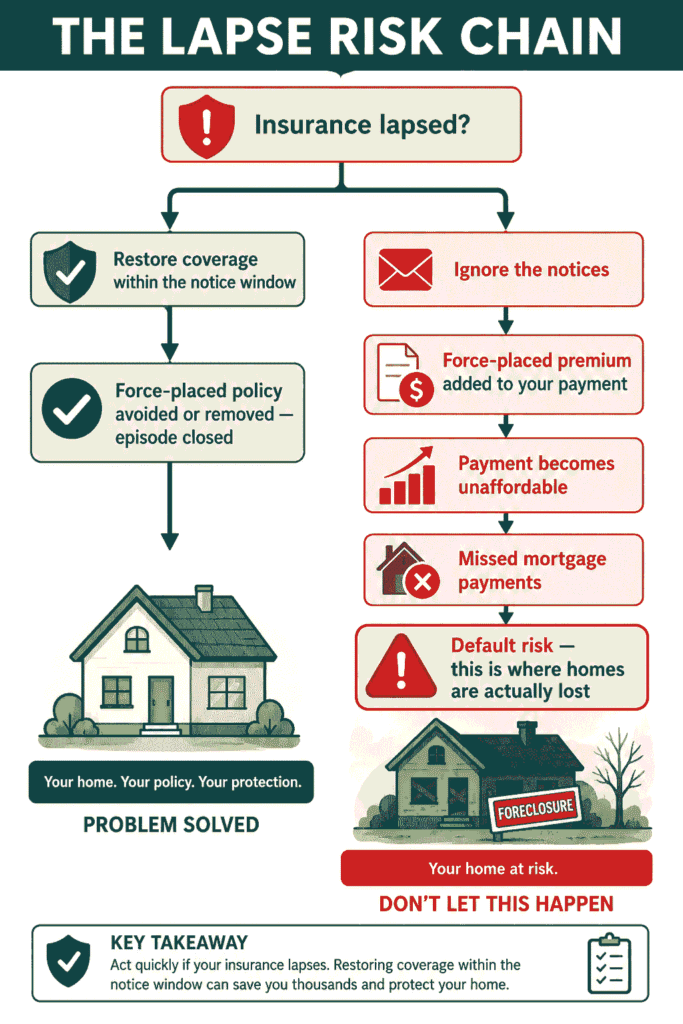
The danger isn’t the lapse – it’s the compounding cost of ignoring it. A force-placed premium two to ten times your old one, folded into your monthly payment, is how a paperwork problem becomes a foreclosure risk eighteen months later.
Insurance Canceled? Do These 6 Things This Week
- Call your insurer – Ask exactly why the policy ended and whether reinstatement is possible. After a missed payment, many insurers reinstate within a grace window.
- Shop replacement coverage immediately – If reinstatement is off the table. Every uninsured day is personal exposure — fire, liability, everything.
- Notify your mortgage servicer proactively – Telling them “coverage is being restored, here’s the timeline” beats letting their tracking system assume the worst.
- Send the declarations page – Showing the lender as mortgagee with the correct loan number.
- Demand removal of any force-placed policy – Under CFPB rules, the servicer must cancel it within 15 days of receiving proof of your coverage and refund premiums for any overlap.
- Verify your next escrow statement – Right premium, no lingering force-placed charges.
Common Mistake: Canceling the old policy before the new one is active — usually to “avoid paying twice.” A one-day gap can trigger the entire lapse machinery, and backdated force-placed premiums cost far more than a few days of overlap ever would. New policy first, cancellation second, always.
Key Takeaways
- Your lender will find out mortgagee-clause notices and escrow monitoring make lapses visible fast.
- You get ~45 days of federally required warning before force-placed charges, use them.
- Force-placed insurance protects the lender, not you no belongings, no liability, at 2–10× the cost.
- Switching insurers is fine, just overlap the dates and send the declarations page yourself.
- Proof of coverage removes force-placed insurance within 15 days, with refunds for any overlap.
If your homeowners insurance lapses, the best response is speed. Restore coverage, notify your mortgage servicer, and provide proof of insurance before force-placed coverage begins. A short gap is a paperwork problem; a long one becomes an expensive contract problem. Resolving it early almost always prevents the costs entirely.
Final Thoughts
If you cancel, lose, or let your homeowners insurance lapse while you have a mortgage, your lender or servicer may find out through insurer notices, insurance tracking, or escrow records.
If a lapse occurs, contact your insurer quickly, arrange replacement coverage if needed, and send proof to your mortgage servicer. If force-placed insurance has already been added, provide evidence of qualifying coverage and ask the servicer to review the related charges.
Always check your mortgage documents and confirm the requirements with your insurer or servicer.
Sources Used
Consumer Financial Protection Bureau (CFPB) – Regulation X force-placed insurance rules and borrower protections
Fannie Mae Servicing Guide – insurance requirements for conventional loans
Freddie Mac Seller/Servicer Guide — property insurance servicing standards
U.S. Department of Housing and Urban Development (HUD) – FHA insurance requirements
State insurance department consumer guidance on cancellation and non-renewal notices
Frequently Asked Questions
Does my mortgage company automatically know if I cancel my insurance?
Usually yes, the mortgagee clause means your insurer notifies the lender of cancellations directly, and escrowed loans surface lapses within days. Timing varies by insurer, servicer, and state, but “they won’t notice” is not a plan.
How long do I have before force-placed insurance starts?
CFPB rules require a first written notice at least 45 days before any force-placed charge, plus a reminder at least 15 days before. Restore coverage within that window and you owe nothing.
Does force-placed insurance cover my belongings or liability?
Generally no — it covers the dwelling for the lender’s benefit only. Your possessions, personal liability, and hotel costs after a disaster are typically unprotected, at two to ten times the price of coverage you’d choose yourself.
Will an insurance lapse hurt my credit score?
The lapse itself isn’t reported to credit bureaus. The danger is indirect: force-placed charges inflate your payment, and missed mortgage payments absolutely damage your credit. Fix the lapse before it reaches your payment.
Can I refuse force-placed insurance?
You can’t refuse it while remaining uninsured — maintaining coverage is a mortgage condition. But you can always replace it: buy your own policy, send proof, and the servicer must cancel the lender-placed coverage within 15 days and refund the overlap.
What if my insurer canceled me by mistake?
Get the error corrected and reinstated in writing, then send your servicer proof of continuous coverage. If force-placed charges were applied for a period you were actually insured, you’re entitled to a full refund of those premiums. If the problem involved a disputed claim or communication with an adjuster, our guide on home insurance claim adjuster tactics provides additional context on the claims process.
Can I switch insurance companies anytime with a mortgage?
Yes — the lender requires coverage, not a specific insurer. Keep the coverage continuous, list the lender as mortgagee, and send the new declarations page to your servicer, and switching is painless.
What happens without an escrow account?
You pay the insurer directly, so lapses may take longer to surface — but tracking services and mortgagee notices still catch them. Non-escrow borrowers also lose the escrow-advance protection, making a fast personal fix even more important.
Editorial Disclaimer: This article is for general informational purposes and is not legal, financial, or insurance advice. Force-placed insurance rules referenced are based on CFPB mortgage servicing regulations (Regulation X) and Fannie Mae/Freddie Mac servicing guidelines as of September 2026; requirements can change and may vary by loan type and state. Notification timing varies by insurer, servicer, and state — the timelines described are typical, not guaranteed. Review your mortgage contract and consult your loan servicer or a licensed professional about your specific situation.