
Quick Answer:
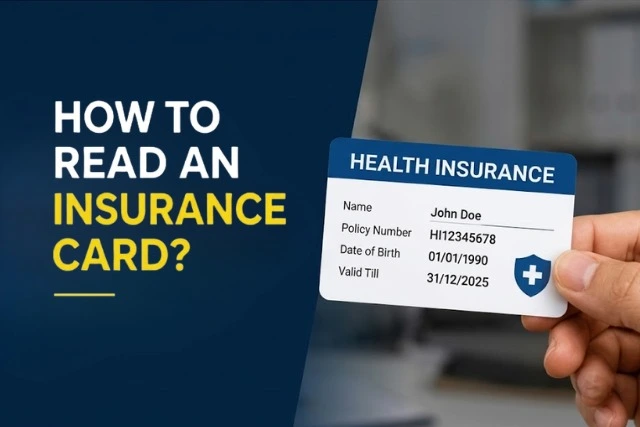
Front of card — look for:
- Insurer name and plan logo
- Your name (policyholder or subscriber name)
- Member ID / Policy number — your personal insurance identifier
- Group number — identifies your employer’s plan (not on all cards)
- Plan type — HMO, PPO, EPO, HDHP, etc.
- Copay dollar amounts — office visits, urgent care, emergency room
- Effective date — when your coverage started
Back of card — look for:
- Insurance company contact information — customer service phone number
- Rx codes — RxBIN, RxGRP, PCN for prescription claims
- Claims mailing address and payer ID
- Network name — e.g., BlueCard PPO, UHC Choice Plus
Knowing how to read an insurance card is one of those things nobody teaches you — and then you’re standing at a doctor’s front desk, receptionist staring at you, while you flip your health insurance card trying to figure out what any of it means. Many people find insurance cards confusing, especially during their first medical visit.
The truth is, every number, code, and dollar amount on that little card has a job. If you’re trying to identify your policy number on an insurance card, we’ve also created a detailed guide that explains exactly where to find it. Some tell your doctor who you are. Some tell the pharmacy which plan to bill. Some tell you exactly how much you’ll owe before you even walk through the door. This guide breaks it all down — field by field, front and back — so the next time someone asks for your member ID or your group number, you know exactly what to hand them.
Before certain treatments or procedures, your insurer may also require preauthorization. Learn what preauthorization means and when it’s needed before receiving care.
What should I look for on my insurance card?
On the front of your insurance card, look for your Member ID (policy number), group number, plan type, and copay amounts. On the back, you’ll find customer service contact details, prescription drug codes (RxBIN, RxPCN, RxGRP), payer ID, and claims information needed by healthcare providers.
What Your Insurance Card Actually Does
Your health insurance card is more than a piece of plastic — it’s proof that you have insurance coverage and it’s the single document that allows every provider you see to correctly bill your plan. When you hand it to a receptionist, they’re pulling off your member ID, your group number, and your insurer’s payer ID to look up your benefits in their billing system and make sure claims go to the right place.
Get any of those numbers wrong — or give the wrong card — and you could end up with a denied claim, a delayed reimbursement, or a surprise bill months later. That’s why it genuinely pays to know how to read your insurance card before you need it.
Reading the Front of Your Insurance Card — Field by Field
| Card Section | Why It Matters |
|---|---|
| Member ID | Identifies you |
| Group Number | Identifies employer plan |
| Plan Type | Shows coverage rules |
| Copay | Shows what you’ll pay |
| Rx Codes | Needed for prescriptions |
| Customer Service | Contact insurer quickly |
1. Insurance Company Name & Plan Logo
The very top of your health insurance card shows who issued it — the name of your insurance company (such as Aetna, Blue Cross Blue Shield, UnitedHealthcare, Cigna, or Humana) along with their logo. This is what your provider uses to find the right billing portal and confirm which company to submit claims to.
Where it is: Top center or top left of the card. Always on the front.
2. Your Name (Subscriber / Policyholder Name)
Your health insurance card shows the name of the primary subscriber — the person who owns the plan. If you bought your own plan, that’s you. If you’re dependent on a parent’s or spouse’s plan, their name may appear as the subscriber, and yours may appear separately or not at all.
This is important information for providers — if the name on the card doesn’t match your ID, it can create billing complications. Always carry the card that has your name on it, or a dependent card if one was issued to you.
Where it is: Front of card, usually upper left below the insurer name.
3. Member ID / Policy Number
This is the one number your doctor, pharmacy, hospital, and specialist all need. Your policy number on your insurance card — often labeled “Member ID,” “Policy #,” “Policy ID,” or simply “ID” — uniquely identifies you within your insurer’s system. Every claim submitted on your behalf uses this number to look up your benefits and process payment.
It may be labeled differently across insurers, but it’s always the primary identification number on the front of the card. On Blue Cross Blue Shield cards it’s labeled “Member ID.” On Aetna cards it’s “Member ID” or “ID.” On UHC cards it appears as “Member ID” or “ID #.” They all mean the same thing. If you don’t have your insurance card with you, you can still find your insurance policy number without a card using your insurer’s online portal, mobile app, or enrollment documents.
Where it is: Front of card, near your name — labeled “Member ID,” “Policy #,” “Policy ID,” or “ID.”
4. Group Number
If your health insurance plan is through your employer, your insurance card will include a group number — also called a group plan number or insurance group number. This code identifies your employer’s specific plan within the insurer’s system. All employees at your company covered by the same plan share the same group number on the insurance card.
Not all cards have one. If you purchased your own plan directly (through Healthcare.gov or an insurer’s website), you typically won’t have a group number — and that’s perfectly fine. Providers ask for it when submitting claims for employer-sponsored plans to ensure the right plan’s benefits apply.
Where it is: Front of card, labeled “Group #,” “Group ID,” or “Grp.” Below or next to the Member ID.
5. Plan Type (HMO, PPO, EPO, HDHP)
The type of plan printed on your card tells you — and every provider — how your insurance coverage works. This affects whether you need referrals to see specialists, how network and out of network care is handled, and what you’ll pay for different types of care.
- PPO (Preferred Provider Organization): Most flexible. You can see any provider — in or out of the network — without a referral. Out-of-network costs more, but you’re covered.
- HMO (Health Maintenance Organization): Must stay in-network and get a referral from your primary care physician (PCP) to see specialists. Lower premiums, less flexibility.
- EPO (Exclusive Provider Organization): In-network only (like HMO), but no referral required (like PPO). No out-of-network coverage except emergencies.
- HDHP (High-Deductible Health Plan): Lower monthly premium but a higher deductible. Often paired with a Health Savings Account (HSA).
Where it is: Front of card, often near the insurer logo or plan name. May say “PPO,” “HMO,” “BlueCard PPO,” “Choice Plus,” etc.
6. Copay Dollar Amounts
The dollar amounts listed on your health insurance card are your copays — fixed amounts you pay each time you use a specific service. These are separate from your deductible. Even if you haven’t met your deductible, you still pay your copay at every eligible visit.
Your card may include separate copay amounts for several types of care:
| Service Type | Typical Copay Range | What It Means |
| Office visits (PCP) | $15 – $40 | Primary care / family doctor visits |
| Specialist | $40 – $80 | Dermatologist, cardiologist, etc. |
| Urgent care | $50 – $100 | Walk-in urgent care clinics |
| Emergency room | $150 – $350 | ER visits (waived if admitted) |
| Preventive care | $0 | Annual physicals, screenings (ACA-mandated) |
If your card shows percentages instead of flat dollar amounts (like “20%” or “30%”), those are coinsurance rates — meaning you pay that percentage of the cost after your deductible is met, not a fixed amount.
Where it is: Front or back of the card, usually in a grid labeled by service type.
7. Effective Date
The effective date tells you when your insurance coverage began. This is important — if you try to use your card before this date, your claims will be denied. Some cards also show a termination date. If your card doesn’t show a date, log in to your insurer’s member portal to confirm when your coverage is active.
Where it is: Front of card, sometimes labeled “Eff. Date,” “Coverage Start,” or “Effective.”
Reading the Back of Your Insurance Card
1. Insurance Company Contact Information
The back of your health insurance card almost always lists the insurance company contact information — including the phone number for member services, a provider line, and often a 24/7 nurse line. This is what you use to call your insurance company when you have billing questions, need to find an in-network provider, want to verify insurance coverage for a specific service, or need to file a complaint.
There may be multiple phone numbers — one for members, one for providers, one for behavioral health, and one for pharmacy. Don’t mix them up — Make sure you call the appropriate department based on your question
Where it is: Back of card, usually at the bottom. May also include a website URL for your member portal.
2. RxBIN, RxPCN, RxGRP — Prescription Codes
These three codes are only relevant when you fill a prescription, but they’re critical for your pharmacy to process it correctly. If a pharmacist can’t find your coverage, they’ll ask for these.
- RxBIN (Bank Identification Number): Routes your prescription claim to the correct insurance processor. Every insurer has a unique BIN code.
- RxPCN (Processor Control Number): Directs the claim to the right pharmacy benefit manager (PBM) within the insurer’s network.
- RxGRP (Rx Group): Identifies your specific prescription group within the plan — similar to a group number but for pharmacy benefits.
If your medication requires insurer approval, you may also need to submit a Cigna pre-authorization form or a similar request depending on your health plan.
Where it is: Usually on the back of the card, sometimes in a shaded section labeled “Pharmacy” or “Prescription.”
3. Payer ID / EDI Number
The payer ID is a unique 5-character code that identifies your insurance company to healthcare provider billing systems. Providers use it to submit electronic claims directly to your insurer. You’ll rarely need this yourself, but if a provider asks for your “payer ID,” it’s on the back of your card — often in fine print near the claims submission address.
Where it is: Back of card, typically in the “Provider Information” or “Claims Submission” section.
4. Network Name & In/Out-of-Network Info
Most health insurance cards identify the plan’s provider network in name – such as BlueCard PPO, UHC Choice Plus, Aetna Open Choice, or Cigna Open Access Plus – and health care providers pull up the name and the list of providers on their plan when asking if you are “in network.”
Understanding network and out of network is crucial. In-network providers have agreed to negotiated rates with your insurer — you pay less. Out-of-network providers haven’t, so your insurer pays a smaller share (or nothing, on HMO and EPO plans). Always confirm a provider is in-network before your appointment by calling the phone number on the back of your card or checking your insurer’s online provider directory.
Where it is: Back or front of card, near the insurer logo or in a network/coverage section.
How to Read an Insurance Card for Major US Insurers?
UnitedHealthcare (UHC) Your Member ID appears on the front labeled “ID” or “Member ID.” Group number is labeled “Group.” Plan name (e.g., “Choice Plus”) is near the top. Copay grid is on the front. The back lists separate phone numbers for member services, behavioral health, and providers. Digital card available instantly via the UHC app or myuhc.com
Blue Cross Blue Shield (BCBS) How to read an insurance card Blue Cross Blue Shield: Your Member ID (called “Subscriber ID” on some BCBS cards) is on the front. The three-letter prefix at the start of your ID identifies your specific BCBS company (e.g., “XYZ”). Blue Cross Blue Shield group number is labeled “Group” or “Grp #.” Plan type may say “BlueCard PPO” or “HMO Illinois.” Each state’s BCBS has slightly different card layouts — find yours at bcbs.com using the “Find My Plan” tool.
How to read an Aetna insurance card: Member ID is on the front labeled “Member ID.” Group number is labeled “Group #.” Plan type appears near the Aetna logo — common options include “Aetna Choice POS II,” “Aetna Open Choice PPO,” and “Aetna HMO.” Copays for office visits, specialist, urgent care, and emergency room are listed on the front or back. The back includes a phone number for Aetna member services (1-800-872-3862) and prescription codes.
In-Network vs. Out-of-Network — What Your Card Tells You
One of the most financially impactful things on your health insurance card is the distinction between network and out of network providers. Your card may show two sets of coverage amounts or percentages — one for in-network and one for out-of-network care.
For example: your card might show “In-network: 80% / Out-of-network: 60%” — meaning after your deductible, your insurance company covers 80% of the allowed amount when you see in-network providers, and only 60% when you go out of network (and only on plans that cover out-of-network at all — HMOs and EPOs generally don’t).
When in doubt about whether a provider accepts your plan, don’t guess — call your insurance company at the phone number on the back of your card, or use your insurer’s online provider directory before scheduling.
Smart Habit: For any non-emergency appointment, call the provider and say: “I have [insurer name], Plan: [type on card], Member ID: [ your ID] – are you in the network?” This simple step can help you avoid unexpected medical bills and appointment delays.
Is Policy Number the Same as Member ID?
On most individual health insurance plans in the US — yes, is policy number the same as member ID — they refer to the same number. Your insurer assigns one primary identifier, and it may appear under different labels depending on which company issued your card.
On family plans, the underlying insurance policy number may be the same for all family members, but each person’s member ID will have a unique suffix (e.g., ending in -00 for the subscriber, -01 for a spouse, -02 for a child). When a form asks for a “policy number,” give your Member ID — that’s what they want.
Final Thoughts
Once you know how to read your insurance card, the whole thing takes about 30 seconds to scan. Your Member ID and group number go to your doctor. The Rx codes go to your pharmacist. The copay amounts tell you what you’ll owe before you even sit down. And the phone number on the back connects you to real answers when something doesn’t add up.
Save a photo of both sides of your health insurance card on your phone right now — front and back. It takes ten seconds and saves a lot of stress at the worst possible moment.
More Free Insurance Guides at USInsurance247 Health, auto, and home insurance — explained simply, no fluff, no sales pressure.
Pro Tip: Keep digital copies of both sides of your insurance card in your phone’s secure wallet or password manager. It ensures you always have your Member ID, group number, and important contact details available during medical visits or emergencies.
Frequently Asked Questions (FAQs)
How do I read an insurance card?
Start with the front: find your Member ID (policy number), group number (if employer-covered), plan type (HMO/PPO), and copay dollar amounts for office visits, urgent care, and the emergency room. On the back: note the insurance company contact information phone number and Rx codes if you fill prescriptions.
How to read an insurance card Blue Cross Blue Shield?
On a Blue Cross Blue Shield card, your Member ID (sometimes called Subscriber ID) is on the front. The three-letter prefix identifies your BCBS company. Blue Cross blue shield group number is labeled “Group” or “Grp #.” Plan type is near the BCBS logo. The back lists your state BCBS customer service phone number. Use bcbs.com → “Find My Plan” to reach your specific state’s member portal.
How to read an Aetna insurance card?
On an Aetna card, Member ID is labeled “Member ID” on the front. Group number is labeled “Group #.” Plan type (e.g., “Aetna Choice POS II”) appears near the logo. Copays for types of care like office visits and urgent care are on the front or back. The insurance company contact information phone number is 1-800-872-3862 for member services.
What are the dollar amounts on my insurance card for?
The dollar amounts are your copays — fixed amounts you pay for specific types of care such as office visits, specialist visits, urgent care, and emergency room visits. Percentage amounts (like “80%”) indicate coinsurance rates for coverage amounts after your deductible is met.
What is the group number on an insurance card?
The group number on your card identifies your employer’s specific health insurance plan. All employees at your company on the same plan share a group number. It’s labeled “Group #” or “Group ID” on the front. If you bought your own plan (not through an employer), your insurance card may not have one — that’s normal.
What does the back of my health insurance card show?
The back typically has: the phone number for your insurer’s member services, a separate provider/claims line, RxBIN/RxPCN/RxGRP prescription codes, the payer ID for electronic claims, and sometimes a claims mailing address. The phone number on the back is your fastest route to answers about insurance coverage — keep it saved in your phone.
Can I use a photo of my insurance card at the doctor’s office?
Many healthcare providers accept a clear photo or digital version of your insurance card, but policies vary by provider. Keeping a digital copy on your phone can help if your physical card is unavailable.
Disclaimer: This article is for general informational purposes only. Insurance card layouts, copay amounts, and coverage details vary significantly by insurer, plan type, and state. Always refer to your specific plan documents or call your insurer’s customer service number for plan-specific details.
Reviewed by Health Insurance Experts
This article has been reviewed by the USInsurance247 Editorial Review team to ensure the information is accurate, current, and easy to understand. Our team verifies health insurance content using trusted industry sources and official guidelines to provide reliable information for readers.